

India vs Philippines Outsourcing (2027): Which Is Better for UK & US Businesses?
20
Nov
- SkyOs BPO Team
- Last Updated: November 20, 2026
- 18 min read
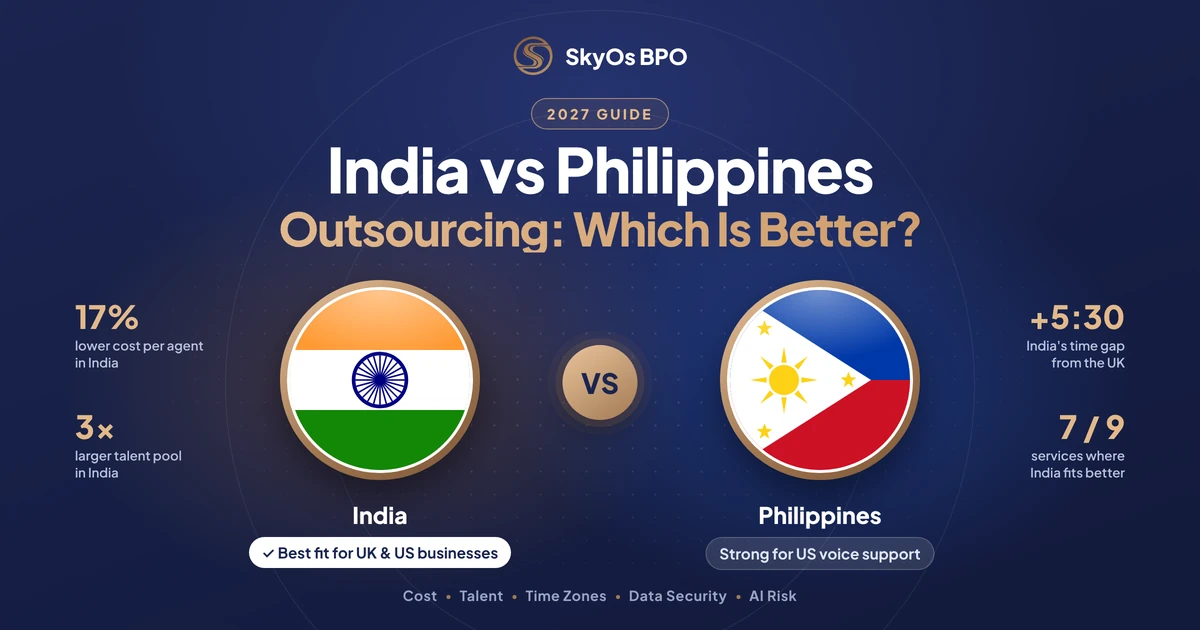
For most UK and US businesses, India is the better place to outsource in 2027. It works out cheaper once employer costs are counted, it has roughly three times the skilled workforce, and Indian working hours sit comfortably alongside the UK day. The Philippines still makes sense in one situation: large volumes of phone support for US consumers, where an American-sounding accent is the top priority.
- Cost: India is typically 15–20% cheaper per agent on a fully loaded basis.
- Talent: close to 6 million people work in India's tech and services sector, compared with about 1.9 million in the Philippine industry.
- UK businesses: India wins, because your outsourced team is online while your own team is.
- Skilled work: India leads for finance and accounting, technical support, data and healthcare BPO.
- Price guide: around $8–$15 an hour for customer support in India and $12–$22 for technical support, compared with $40–$80 an hour in the US. SkyOs BPO starts from $8 an hour.
Almost every UK or US business that starts looking at outsourcing ends up with the same two names on the shortlist: India and the Philippines. Between them, they handle a huge share of the world's offshore customer service, back-office and IT support. And almost everyone you ask has a firm opinion on which is better, usually because they only work in one of them.
We get this question from clients all the time, so we have put our full answer in one place. For most businesses, India comes out ahead. The Philippines has one area where it is really strong. Below, we compare India vs Philippines outsourcing on cost, talent, time zones, data protection, communication, staff turnover and AI, then go through the main outsourcing services one by one so you can see which country suits your work. If you are still deciding whether to outsource at all, start with When Should a Business Outsource?
India vs Philippines Outsourcing at a Glance
If you only have two minutes, this table covers the main differences:
| Factor | India | Philippines |
|---|---|---|
| Strongest for | Back office, finance and accounting, technical support, data, healthcare BPO | Voice customer service, virtual assistance, entry-level back office |
| Industry size | About $315 billion and nearly 6 million people in tech and services | About $40 billion and 1.9 million people in IT-BPM |
| English | The working language of business and higher education; British-influenced; accents vary by region | Neutral, American-influenced accent; 28th in the EF English Proficiency Index 2025 |
| Time difference from UK | +5:30 (+4:30 during British Summer Time) | +8 (+7 during British Summer Time) |
| Time difference from US East Coast | +10:30 (+9:30 during US daylight time) | +13 (+12 during US daylight time) |
| Typical hourly cost | $8–$15 for customer support | $10–$18 for customer support |
| Data protection law | Digital Personal Data Protection Act 2023 and DPDP Rules 2025 | Data Privacy Act 2012 |
| Best fit | Most UK and US businesses, especially for skilled, technical, finance and non-voice work | US businesses with high-volume, accent-led phone support |
6 Reasons India Comes Out Ahead
Each of these is covered in more detail further down, but this is the case for India in brief:
- You pay less per agent. Industry estimates put a fully loaded customer service agent at about 17% less in India than in the Philippines, and the difference grows when you need night shifts for US cover.
- There are far more people to hire from. India's tech and services workforce is close to 6 million, about three times the size of the Philippine industry. That means roles are filled faster, and when someone leaves, a replacement is easier to find.
- Skilled work is India's home ground. Bookkeeping, payroll, L2 and L3 technical support, data processing and medical billing and coding all need people with commerce, accounting or technical training, and India produces them in large numbers every year.
- It fits the UK working day. India is 4.5 to 5.5 hours ahead of the UK. The Philippines is 7 to 8 hours ahead. With India, your outsourced team is working while you are.
- It is the world's biggest outsourcing destination. Even the Philippine industry association describes its own country as number two, behind India.
- Written communication is a strength. Indian business and higher education run in English, and it shows in the quality of emails, chat replies, documentation and back-office records.
Cost Comparison: What You Actually Pay in 2027
Price is nearly always the first thing people ask about, and it is also where many comparisons mislead. They line up local salaries, but you never pay a salary when you outsource. You pay an invoice, and the invoice includes a lot more.
Hourly rates through an outsourcing provider
A managed provider charges an hourly or monthly rate per agent. That rate already covers the salary, office space, equipment, team leaders, quality checks and IT. Based on rates that providers publish, this is roughly what to expect:
| Service | India | Philippines | United States |
|---|---|---|---|
| Customer support (phone, email and chat) | $8–$15/hr | $10–$18/hr | $40–$80/hr |
| Back office and data entry | $8–$14/hr | $9–$15/hr | $35–$60/hr |
| Technical support | $12–$22/hr | $13–$23/hr | $50–$100/hr |
| Finance and accounting | $12–$22/hr | $15–$25/hr | $40–$70/hr |
Treat these as guide ranges, not quotes. Your own price will depend on the skills you need, your hours, your volumes and whether the agents work only for you. Across every service, India comes in at the same price or lower, and the gap is biggest on skilled roles, where India simply has more people to choose from.
What the hourly rate does not show
Look past the hourly rate and India's lead gets wider. Published industry estimates for 2026 put the fully loaded cost of a customer service agent at around $6,500 a year in India and $7,800 in the Philippines, so India is about 17% cheaper. Two Philippine labour rules account for part of that difference:
- 13th-month pay: by law, every employee receives an extra month's salary each year. That adds 8.33% to the wage bill before anything else is counted.
- Night-shift premium: work between 10pm and 6am must be paid at an extra 10%, and that is exactly when US daytime support happens.
To be fair, Indian employers have their own costs, such as provident fund and health insurance, and Indian salaries go up faster each year. Even so, the cost per agent stays lower. That is why we always tell clients to compare fully loaded quotes, never salaries.
Whichever country you pick, these are the costs that never appear on a rate card:
- Training time: the weeks before a new agent can work without someone checking every reply.
- Rework: tickets, invoices or records that have to be corrected later.
- Your own time: the hours your managers spend reviewing outsourced work.
- Staff turnover: each new starter means more training and, for a while, lower quality.
In our experience, a provider that costs $2 more an hour but gets things right the first time ends up cheaper almost every time.
Example: a five-person support team
Say you run a UK online shop and need five full-time agents on email and chat, 40 hours a week each. That comes to roughly 870 hours a month.
| Option | Typical rate | Approximate monthly cost |
|---|---|---|
| Managed team in the UK | £24–£39 an hour | £21,000–£34,000 |
| Outsourced to the Philippines | $10–$14 an hour | $8,700–$12,200 |
| Outsourced to India | $8–$11 an hour | $7,000–$9,600 |
Both offshore options cost well under half of a UK-based team. India saves the most, though: up to about $2,600 a month compared with the Philippines, which is more than $30,000 a year on a team of only five people. And for a UK business, the Indian team also covers much more of your own working day. To see how providers structure their charges, read our guide to call centre outsourcing pricing models.
Talent and Skills: Who Is Better at What?
Cost gets the attention, but talent is where the two countries differ most.
Where India is stronger
India's edge is depth. Nasscom estimates that nearly 6 million people work in the country's tech and services sector, and every year brings a new wave of commerce, accounting, engineering and science graduates. It is the reason most of the top BPO companies in India focus on skilled work, and it makes these teams much easier to build:
- Finance and accounting: bookkeeping, payables and receivables, reconciliations and payroll.
- Technical support: particularly L2 and L3, where knowing the product and the systems matters far more than accent.
- Data and analytics: data processing, reporting and document indexing.
- Healthcare BPO: medical billing and coding for US healthcare providers.
Where the Philippines is stronger
The Philippine industry grew up answering phones for American companies, and that history shows. Agents usually have a neutral, American-influenced accent and a relaxed, friendly manner that a lot of US callers like. The industry employs about 1.9 million people, and its own trade body ranks the country as the world's second-largest outsourcing destination, after India.
What this means for you
If your work is mostly phone calls with US consumers, the Philippines starts with an advantage. If it involves numbers, systems, documents or written replies, or if your customers are in the UK, India will usually give you a bigger and better-qualified pool of people.
India vs Philippines: Service-by-Service Comparison
"It depends" is not much help when you have a decision to make, so this is how we see each service, based on how these teams tend to perform in practice:
| Service | Better fit | Why |
|---|---|---|
| Inbound customer support for US consumers | Philippines or India | The Philippines suits accent-led calls; India suits support that needs product or technical knowledge, at a lower cost |
| Customer support for UK customers | India | Live overlap with the UK day and familiarity with UK business culture |
| Email and live chat support | India | Strong written English at a lower cost |
| Technical support (L1, L2, L3) | India | A much larger technical talent pool for L2 and L3 |
| Back office and data entry | India | Scale, accuracy and cost |
| Finance, bookkeeping and payroll | India | Deep accounting and commerce talent |
| Medical billing and medical coding | India | A long track record with US healthcare providers |
| Content moderation | Either | Depends on the languages, culture and hours you need |
| Lead generation and appointment setting | Either | India for research and email outreach; the Philippines for high-volume US cold calling |
Count it up and India is the better fit for seven of the nine services and level on the other two. The Philippines only pulls ahead when an American-sounding voice on the phone matters more than anything else.
Time Zones: Which Works Better for UK and US Businesses?
Time zones rarely make the headlines in these comparisons, yet they affect how working with your team feels every single day.
For UK businesses
India is five and a half hours ahead of the UK in winter and four and a half in summer. When you sit down at 9am in London, it is 2:30pm in India, so a team on a slightly later shift is online for most of your day. You can hand over work at lunchtime and have it back before you go home, and a quick question gets a quick answer.
The Philippines is eight hours ahead in winter. By 9am in London it is already 5pm in Manila, so covering UK hours means agents working well into the night from the moment your day begins. It can be done, but you lose the easy overlap that India gives you.
| UK time (GMT) | India (IST) | Philippines (PHT) |
|---|---|---|
| 9:00am | 2:30pm | 5:00pm |
| 1:00pm | 6:30pm | 9:00pm |
| 5:00pm | 10:30pm | 1:00am |
For US businesses
Neither country naturally shares the US working day, so live US support means night shifts in both, and both industries are well practised at running them. Where offshore teams really help US businesses is overnight work: back-office tasks, data processing and ticket queues cleared while you sleep and ready when you log in. India's larger non-voice workforce makes this model especially easy to staff.
This is how the start of the US working day lines up:
| US time (standard time) | India (IST) | Philippines (PHT) |
|---|---|---|
| 9:00am New York | 7:30pm | 10:00pm |
| 9:00am Los Angeles | 10:30pm | 1:00am |
An Indian team that starts in the early evening can cover the East Coast morning without working through the small hours, and shifts like that are easier to fill and keep filled. If you need cover around the clock, see how 24/7 customer support works in practice.
Public holidays and cover
Both countries have public holidays that do not match UK or US calendars, such as Diwali in India and Holy Week in the Philippines. A well-run provider plans for them with cross-trained back-up agents and a holiday calendar agreed with you in advance, so your service carries on as normal. Ask to see that calendar before you sign anything.
Data Security and Compliance
If you are a UK or EU business, the country your data travels to matters just as much as the people handling it.
India
India's Digital Personal Data Protection Act 2023 is now coming into force. The government published the DPDP Rules in November 2025, and the obligations are being phased in over 18 months, finishing in May 2027. Many Indian providers also hold ISO/IEC 27001 certification for information security, and the more established ones are registered with the UK Information Commissioner's Office (ICO).
Philippines
The Philippines has had its Data Privacy Act since 2012, enforced by the National Privacy Commission. It is a well-established law, and the larger BPO operators there are used to being audited by American clients.
What UK businesses must check, whichever country you choose
| Factor | India | Philippines |
|---|---|---|
| Main law | Digital Personal Data Protection Act 2023, with DPDP Rules 2025 | Data Privacy Act 2012 (Republic Act 10173) |
| Regulator | Data Protection Board of India | National Privacy Commission |
| UK adequacy decision | No | No |
| What a UK business needs | IDTA or UK Addendum, risk assessment, DPA | IDTA or UK Addendum, risk assessment, DPA |
Neither country has a UK adequacy decision, so sending personal data to either one needs exactly the same paperwork:
- A transfer mechanism: the UK International Data Transfer Agreement (IDTA), or the UK Addendum to the EU Standard Contractual Clauses.
- A transfer risk assessment: a written check that your data will actually be protected once it arrives.
- A data processing agreement: spelling out exactly what the provider is allowed to do with your data.
- Evidence of security: ISO/IEC 27001 certification, access controls and a plan for handling breaches.
In other words, data protection should not push you towards one country or the other. It should push you towards a provider that takes it seriously. Our UK GDPR guide to outsourcing to India and data security checklist walk through each step.
Communication, Culture and Working Style
Both countries speak English, but not in quite the same way. In the EF English Proficiency Index 2025, the Philippines came 28th of 123 countries, in the "high proficiency" band, and India came 74th. That national average says little about the people you would actually work with, though. English is the everyday language of Indian business, universities and the outsourcing industry, and agents hired through a good provider are tested and trained on it.
Day to day, the difference is more about style than ability:
- Filipino teams are known for a warm, informal tone that suits many US consumer brands.
- Indian teams tend to excel at clear written communication and process-driven work, and many already know British spelling, business etiquette and how UK companies operate.
Accents vary widely inside both countries, so one call is no basis for judging a whole nation. Ask for sample calls and emails, speak to the team leads who would run your account, and run a short pilot before you commit.
Staff Turnover and Team Stability
High staff turnover affects outsourcing in both countries, most of all in large call centres where agents can switch employers with little effort. Each departure costs you, in retraining and in product knowledge that walks out the door.
In practice, turnover depends much more on the provider than on the country. Before you sign, ask:
- Will my agents work only on my account, or will they be shared with other clients?
- Who will be my account manager, and will that person stay with my account?
- How will my processes be written down so a new agent can pick them up quickly?
- What has your staff turnover been over the last 12 months?
A dedicated team, a named manager and properly documented processes will protect you from turnover wherever your team is based.
AI and Outsourcing: Which Country Is Better Placed for 2027?
AI is already changing the work outsourced teams do, and it is not affecting the two countries in the same way.
Much of the Philippine industry is built on customer support, transcription, document processing and data entry. In its World Development Report 2026, published in August 2026, the World Bank named the Philippines as one of the economies most exposed to generative AI, largely because so much of its outsourcing work falls into those categories. The International Labour Organization estimates that more than a quarter of jobs in the Philippines are exposed to generative AI, the highest share among ASEAN countries with comparable data. The industry itself has reacted: in July 2026, the Philippine industry association IBPAP lowered its 2028 forecast from 2.5 million workers to between 1.85 and 2.14 million, pointing to AI and tougher global competition.
India is not immune. The same World Bank report says entry-level outsourcing work is under pressure in both countries. What differs is the mix of work. A much bigger share of India's outsourcing workforce does finance, technical, data and knowledge work, where AI tends to help people work faster rather than replace them.
What this means for you: do not pick a country just because it has the most agents. Pick a partner whose teams already use AI for drafting, quality checks and routine tasks, while trained people stay responsible for judgement, accuracy and your customers. That gives you lower costs today and a team that will still suit your business two years from now. Our article on AI in customer support outsourcing explains how this works.
Can You Use Both? The Hybrid Model
You can, and some growing businesses do. A typical split is US phone support from the Philippines, with back office, finance, data and technical work from India, so each country handles the work it is best at.
The downside is the extra management. Two providers means two contracts, two sets of reports, two data processing agreements and two relationships to keep on track. If you are just starting out, it is usually simpler to choose one provider that can do both voice and non-voice work, review the results after three months, and only split the work later if one area clearly needs it. Our guide to multichannel customer support outsourcing shows how a single team can handle phone, email and chat together.
How to Choose: A 5-Question Checklist
Work through these five questions and the answer usually becomes clear:
- Where are your customers? If they are in the UK, look at India. If they are US consumers who mainly phone you, the Philippines is worth considering.
- Is the work mostly voice or non-voice? Heavy phone volumes lean towards the Philippines. Email, chat, data, documents and back-office work lean towards India.
- How specialised is it? Finance, technical support, healthcare and analytics all favour India's larger talent pool.
- How sensitive is your data? Wherever you go, insist on ISO/IEC 27001, a data processing agreement and, for UK data, an IDTA.
- How much overlap do you need? If your team needs answers during the UK working day, India's time zone is very hard to beat.
Tip: whichever country you choose, begin with a 60–90 day pilot on a single process. Agree clear targets for response time, accuracy and customer satisfaction, and only scale up once the numbers hold steady. Our guide on how to choose the best BPO service provider in India has a fuller checklist.
Why UK and US Businesses Choose SkyOs BPO in India
SkyOs BPO is a specialist outsourcing partner for UK and US businesses. Our delivery centre is in Mohali, Punjab, and we have an office in Wilmington, Delaware. We run voice and non-voice work under one roof, so you can start with a single provider.
- Certified security: ISO 9001:2015 and ISO/IEC 27001:2022 certified, and registered with the UK ICO.
- Dedicated teams: agents who work only on your account, with a named account manager.
- Hours that suit you: UK daytime cover, US night shifts or full 24/7 support.
- Clear pricing: from $8 an hour, with a written, fully loaded quote. See our pricing page.
Weighing up your options? Get a free quote and we will tell you honestly whether your work suits India, and if any part of it would be better handled another way.
Conclusion
For most UK and US businesses, India is the stronger choice. It costs less once everything is counted, it has about three times the workforce, it leads on skilled work such as finance, technical support, data and healthcare BPO, and it shares a large part of the UK working day. The Philippines is still a fair option if nearly all your work is US phone calls and accent is your biggest concern.
Start from what your work really needs, compare fully loaded quotes instead of salaries, get your data protection agreed in writing, and run a pilot before you scale. If you want a straight answer on whether India is right for your business, talk to SkyOs BPO or email info@skyosbpo.com.
Frequently Asked Questions
Is India or the Philippines better for outsourcing?
For most businesses, India. It costs less once employer costs are included, it has a much bigger skilled workforce, and it is stronger in back office, finance and accounting, technical support, data and healthcare BPO. UK businesses also benefit from the time-zone overlap. The Philippines is mainly the better pick for high-volume US phone support.
Is outsourcing cheaper in India or the Philippines?
India is cheaper. Industry estimates put a fully loaded customer service agent at about $6,500 a year in India and $7,800 in the Philippines, around 17% less. Customer support typically costs $8–$15 an hour in India and $10–$18 in the Philippines, compared with $40–$80 an hour in the US.
Is the Philippines overtaking India in outsourcing?
No. India is still the largest outsourcing destination in the world, and the Philippine industry association IBPAP describes its own country as second. In July 2026, IBPAP also lowered its 2028 forecast from 2.5 million workers to between 1.85 and 2.14 million, pointing to AI and global competition.
Which country is better for customer service outsourcing?
For most businesses, India. It is the stronger choice for email and chat, for UK customers, for technical support and for any support that needs real product knowledge, and it costs less. The Philippines has a small edge only for US phone support where an American-sounding accent matters most.
Is India or the Philippines better for UK businesses?
India. It is only 4.5 to 5.5 hours ahead of the UK, so an Indian team is online for much of your working day, while the Philippines is 7 to 8 hours ahead. Many Indian teams also know British spelling and how UK companies work.
Is it safe to send UK customer data to India?
Yes, as long as the right safeguards are in place. India has no UK adequacy decision, so you need the UK IDTA or the UK Addendum, a transfer risk assessment and a data processing agreement. Choose a provider that is ISO/IEC 27001 certified and registered with the UK ICO.
Can I outsource to both India and the Philippines?
Yes. Some businesses use the Philippines for US phone support and India for back office and technical work. It can work well, but you then have two providers to manage, so most businesses start with one provider that handles both voice and non-voice work.
Will AI replace outsourcing jobs in India or the Philippines?
AI is changing outsourcing in both countries. The World Bank named the Philippines as one of the economies most exposed to generative AI, because so much of its industry is customer support, transcription, document processing and data entry. Your safest option is a partner that uses AI tools but keeps trained people in charge of judgement, accuracy and customer contact.
How quickly can I start an outsourced team in India?
With an established provider, a small team typically goes live in 2–4 weeks once your requirements, training and data protection paperwork are agreed. Specialist roles, such as finance or L3 technical support, can take longer. Ask your provider for a written onboarding plan with dates.

SkyOs BPO Team
The SkyOS BPO Team is a group of outsourcing specialists delivering end-to-end solutions across customer support, healthcare BPO, finance & accounting, data entry and processing, IT services, and back-office operations. We partner with global organizations to improve efficiency, maintain compliance, and drive sustainable growth.
Leave A Comment