

Data Security in Outsourcing: How to Choose a Secure BPO Partner
16
Sep
- Admin
- 0 Comments
- Last Updated: September 16, 2026
Outsourcing data entry, back office work, or customer support means handing sensitive information, customer records, invoices, financial data, sometimes login credentials, to a team outside your own walls. This guide breaks down the specific security measures a trustworthy BPO partner should have in place, the compliance certifications that actually mean something, the red flags to watch for, and the exact questions to ask before you sign a contract.
You will also find a breakdown of how technical controls, legal safeguards, and physical security work together, and how SkyOS BPO approaches data protection for the clients we work with.
- → Data security should be part of vendor evaluation from the first conversation, not a clause you skim before signing.
- → A reliable BPO partner should offer encryption in transit and at rest, role-based access control, and multi-factor authentication as standard, not optional extras.
- → Signed NDAs and Data Processing Agreements are baseline legal protection, and should be in place before any file is shared.
- → Depending on your industry and the type of data being handled, look for relevant security certifications, audit reports, and evidence of compliance with applicable regulations and standards, such as ISO/IEC 27001, SOC 2, GDPR, HIPAA, or PCI DSS.
- → Vague answers, expired certifications, or reluctance to share documentation are the biggest warning signs a provider is not actually secure.
- → Ask for proof, not promises, and expect a written incident response and data deletion policy.
- → Responsibility for customer data does not fully transfer to the vendor. Your business remains accountable even after outsourcing.
Every outsourcing conversation eventually lands on the same question: is our data actually safe with them? It is a fair question, not a paranoid one. Once your data leaves your building, the risk does not disappear. It just moves to a partner you need to trust.
This guide covers what a legitimate BPO or data entry provider should be able to show you, what certifications are worth asking about, and what should make you walk away before signing anything. If you are still deciding whether outsourcing makes sense for your business at all, our guide on what business process outsourcing is a good starting point before diving into security specifics.
Why Data Security Deserves More Than a Passing Question
Outsourcing has grown because it works. It is faster, more cost effective, and frees up internal teams to focus on higher value work. That growth has also made outsourced vendors an attractive target. A single data entry team can touch thousands of customer records in a week. If that pipeline is not secured properly, a single weak point, such as an unencrypted file, a shared login, or an untrained new hire, can create a serious problem.
The cost of getting this wrong is not abstract. A breach can mean regulatory fines, client attrition, and reputational damage that outlasts the financial hit by years. Under most data protection laws, responsibility does not shift entirely to the vendor. Your business remains accountable for how customer data is handled, even when someone else is handling it day to day.
That is why "we take security seriously" is not a real answer. Every vendor says that. What actually matters is proof.
Core Security Measures a Reliable BPO Partner Should Have
Here is what a legitimate data entry or BPO vendor should have in place, technically and operationally, before you sign a contract.
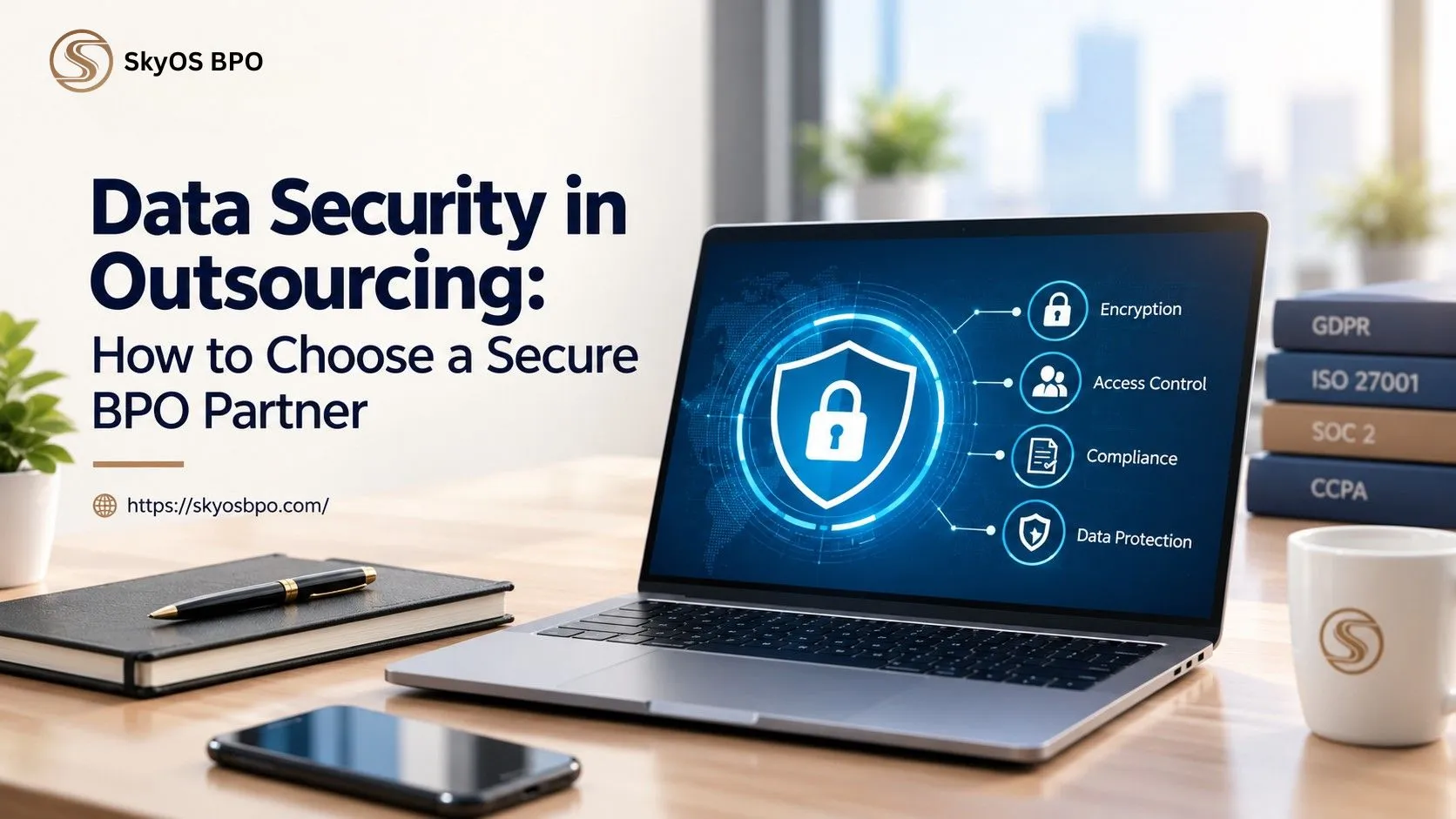
- Encryption in transit and at rest. Your data should be unreadable to anyone who intercepts it, whether it is moving between systems or sitting in storage. In practice, this means encrypted file transfers such as SFTP or secure APIs, not email attachments, along with encryption standards like AES 256 for stored data and TLS 1.2 or higher for data in motion. A vendor still moving spreadsheets over email is a warning sign, not a minor gap.
- Role based access control.Not every employee at a BPO needs access to every client's data. A properly run operation restricts access by role and project, so an associate working on your account cannot open files belonging to another client. Ask specifically how access is granted, reviewed, and removed when someone changes roles or leaves the company.
- Multi factor authentication. Passwords alone are not sufficient. MFA should be standard across every system that touches client data, not something offered on request.
- Non disclosure and data processing agreements.Legal safeguards matter as much as technical ones. A serious partner offers a signed NDA as a baseline, along with a Data Processing Agreement that spells out exactly how your data can and cannot be used, stored, and shared, including with any subcontractors.
- Employee vetting and ongoing training. Most security incidents come from human error, not sophisticated hackers. Ask whether staff go through background checks before being assigned to sensitive projects, and whether security training happens once at onboarding or continues on a recurring basis.
- Regular security audits and monitoring. Security is a maintained process, not a one time setup. Look for evidence of internal audits, vulnerability scans, and real time monitoring for unusual account activity. Ask when the last third party audit took place and whether a summary is available to review.
- Physical security controls. For any provider handling data on site, this includes badge or biometric access to production floors, CCTV coverage, visitor logs, and clean desk policies that keep printed information from sitting out unattended. This applies just as much to back office teams handling physical documents as it does to purely digital workflows.
Compliance Certifications That Actually Mean Something
Certifications are proof that a third party has verified a vendor's claims, not decoration on a website. Here is what to look for and why each one matters.
| Certification | What It Verifies |
|---|---|
| ISO/IEC 27001 | A documented, audited information security management system |
| SOC 2 Type II | Security controls tested over a period of time, not a single snapshot |
| GDPR Compliance | Required if you serve customers in the EU or UK, regardless of vendor location |
| HIPAA Safeguards | Administrative, technical, and physical protections for healthcare data |
| PCI DSS | Required if any part of the workflow touches payment card data |
If a vendor claims all of these but cannot produce documentation on request, treat that as a bigger warning sign than not holding the certification at all. You can see the specific certifications SkyOS BPO holds, including ISO 9001:2015 and ICO registration, on our certifications page.
Red Flags That Suggest a BPO Partner Is Not Secure
Some warning signs show up before you even reach the technical questions.
- Vague or evasive answers when you ask for documentation
- No willingness to sign an NDA or DPA before discussing your data
- Certifications mentioned but not verifiable or expired
- Data shared over regular email instead of secure channels
- No clear answer on where your data will physically be stored
- No documented incident response plan
One vague answer might be a communication gap. Two or three together usually means the security program does not extend much beyond a slide in a sales deck. For a broader look at vetting vendors beyond security alone, our guide on how to choose the best BPO service provider in India covers the full evaluation process.
How SkyOS BPO Approaches Data Security
We built our data handling process around one principle. Your client's trust in you should not depend on hoping our team gets it right. That means encrypted data transfer by default, never email, strict role based access so only the people assigned to your project can see your files, and NDAs signed before a single file changes hands. Our teams complete security training during onboarding and again on a recurring basis, not just once.
For more detail on the specific controls and certifications we maintain, our data security page covers it further, and our data entry services page outlines how these safeguards apply day to day. If you have other questions about how we operate, our FAQ page covers common ones.
Conclusion
Choosing an outsourcing partner on price and turnaround time alone is how businesses end up with a data problem instead of a data solution. Security should be part of the evaluation from the first conversation, not a clause you skim before signing. Ask for proof, expect documentation, and do not settle for reassurance without evidence.
If you are evaluating outsourcing partners and want to see how our security practices hold up, get in touch with our team to walk through our certifications and processes in detail.
Leave A Comment