

Multichannel Customer Support Outsourcing (UK & US): Costs, BPO & ROI (2026)
2
Jun
- Admin
- 0 Comments
- Last Updated: October 5, 2026
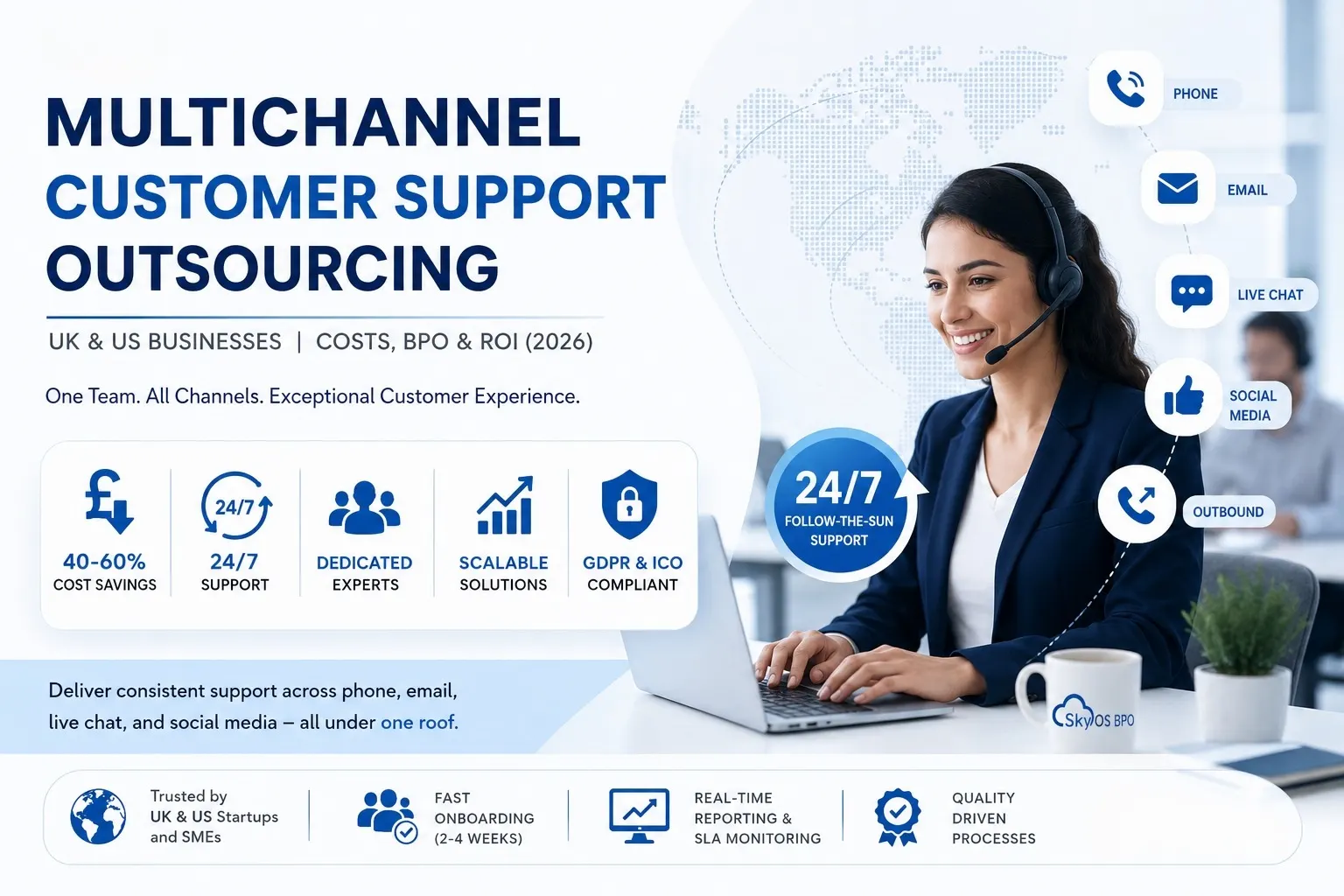
- What it is: Multichannel customer support outsourcing means hiring a single BPO provider to manage phone, email, chat, and social media from one coordinated team.
- Cost advantage: Reduces operational costs by 40 to 60 percent versus equivalent in-house UK or US teams.
- 24/7 support: India-based follow-the-sun model covers the UK and US overnight hours at no extra premium.
- Best for: UK and US startups and SMEs scaling support without building multi-desk in-house teams.
- → Outsourcing to a multichannel BPO cuts support costs by 40 to 60 percent without sacrificing quality.
- → One dedicated team handles phone, email, live chat, and social media under consistent SOPs and brand guidelines.
- → Go-live happens in two to four weeks — far faster than recruiting and training an in-house multichannel team.
- → ICO-registered, GDPR-aligned providers like SkyOS BPO handle all data protection obligations so you do not have to.
Is your customer support team losing track of conversations because they are scattered across phone, email, chat, and social media? If yes, you are in exactly the right place. This guide will walk you through how to fix that, without tripling your headcount or your monthly costs.
Here is the reality most businesses face. A customer sends an email about a delayed order. No response arrives within two hours. That same customer opens a live chat. The chat agent knows nothing about the email. They then call in, frustrated, and explain everything from scratch. That experience is not just frustrating. It is the most common reason customers stop buying from a brand.
According to a 2026 report by EverHelp, 73 percent of customers want interactions tailored to their history and expect continuity across channels. Yet most growing businesses still manage their support channels separately. That is exactly why response times slip, brand voice drifts, and support costs keep climbing.
Multichannel customer support outsourcing solves that directly. One coordinated BPO team handles all your channels under a single contract, with consistent training, shared SOPs, and real-time quality monitoring. Read on to see exactly how it works, what it costs, and how to choose the right partner:
What Is Multichannel Customer Support Outsourcing?
What is multichannel customer support outsourcing? It is hiring a BPO provider to manage customer interactions across phone, email, chat, and social media from one coordinated team, rather than building separate in-house desks for each channel.
Multichannel customer support outsourcing is the practice of hiring a specialist BPO provider to manage your customer interactions across multiple channels from a single, coordinated team. Rather than building separate internal desks for each channel, you partner with one provider who covers all of them under agreed service levels and defined SLAs.
The real difference is coordination across channels. This is not the same as simply having a call centre that also replies to emails when someone has time. A proper multichannel customer support service means your agents are trained across all your active channels. Your brand voice stays consistent whether a customer calls, chats, or emails. Your response time SLAs are defined and monitored per channel, not just assumed.
Why UK and US Businesses Are Moving Toward Multichannel Support?
For UK and US businesses specifically, this model is gaining real traction in 2026. Rising salaries, increased employee attrition in customer service roles, and the growing expectation of 24/7 customer support outsourcing are making in-house multichannel teams expensive and difficult to sustain. Outsourcing the function to a trained BPO provider removes that overhead, so quality holds without the cost of building it internally.
A call centre that handles only voice calls is not multichannel. A generic virtual assistant is not multichannel. What qualifies is a dedicated team that manages your full channel mix: inbound calls, outbound follow-ups, email tickets, live chat, and social media response, with shared briefings, escalation paths, and quality controls running across every one of them.
Multichannel vs Omnichannel Support: What Is the Real Difference?
Multichannel vs omnichannel — which is better for SMEs? Multichannel is the practical, cost-effective starting point. Omnichannel requires full CRM unification and is better suited to large enterprises with complex, cross-channel customer journeys.
This is the most common point of confusion in customer experience. The two terms are used interchangeably in most conversations, yet they describe very different operating models. Understanding the difference will save you from choosing the wrong setup — and the wrong budget.
| Factor | Multichannel Support | Omnichannel Support |
|---|---|---|
| Definition | Multiple channels managed as a coordinated set | All channels fully unified with shared real-time customer history |
| Customer History | The customer may need to re-explain the context when switching channels | Agent sees full cross-channel history in real time |
| Complexity | Lower channels share SOPs and brand briefings | Higher: requires deep CRM and platform unification |
| Best For | SMEs scaling support across 2 to 5 channels | Enterprises with complex, high-volume customer journeys |
| Cost | Significantly lower, no full platform integration needed | Higher, full CRM unification required |
| SkyOS BPO Model | Fully delivered: trained agents, shared SOPs, coordinated channel management | Available as an upgrade for clients with existing unified CRM |
For most UK and US startups and SMEs, multichannel outsourcing is the practical entry point. It delivers real consistency across your customer channels at a fraction of the cost and complexity that full omnichannel requires. Omnichannel becomes a worthwhile investment once your business is operating at a scale where customers are moving between five or more channels within a single interaction and full context continuity at every handoff genuinely changes the outcome.
We operate on a coordinated multichannel model at SkyOS BPO. Your customers will not experience disconnected interactions. Agents share brand briefings, escalation protocols, and quality standards, so the tone and quality hold whether a customer calls, emails, or messages your social page.
Which Channels Does Multichannel BPO Cover?
A proper multichannel BPO setup covers far more than a phone queue. Here is what a well-structured engagement actually includes and what each channel contributes to your overall customer experience.
Phone: Inbound Call Handling
Phone remains the highest-stakes customer support channel. It is where complex complaints land, where frustrated customers escalate, and where your brand tone is tested under real pressure. Inbound call handling through a BPO provider covers product queries, order issues, complaint resolution, account support, and general enquiries: all handled by agents trained specifically on your brand, escalation rules, and tone expectations.
The advantage of outsourcing inbound calls is round-the-clock coverage across the UK and US time zones without staffing night shifts or paying unsociable hours premiums. Learn how per-minute, per-call and dedicated-agent pricing compare. Our Mohali operations run on a follow-the-sun model, so your UK customers get responses at the start of their working day, handled overnight by a trained team.
For how we structure dedicated phone support for UK and US clients, check out our customer support outsourcing services.
Outbound Calling
Outbound calling through a multichannel BPO covers follow-up calls after a support resolution, renewal reminders, customer satisfaction calls, appointment confirmations, and re-engagement outreach for lapsed customers.
This channel gets neglected when businesses manage support in-house; reactive inbound volume always takes priority. An outsourced team can run both simultaneously with no trade-off required. Proactive outreach improves customer retention measurably, and retention costs considerably less than acquisition in almost every business model.
Email Support
Email support outsourcing through a multichannel BPO covers ticket categorisation, SLA-based response management, template creation, and quality monitoring to keep response accuracy consistent.
The critical element in email support is response time. Customers who receive a reply within four hours are significantly more likely to remain loyal than those who wait longer. A dedicated outsourced email team operating outside your standard business hours keeps your inbox covered overnight and over weekends, so no customer is left waiting until Monday morning for an answer sent on Friday.
Live Chat
Live chat support outsourcing covers your website chat and WhatsApp Business across every platform your customers prefer. Live chat is your real-time conversion tool; a customer who opens a chat window and receives a response within 30 seconds is dramatically more likely to complete a purchase than one who waits two minutes.
First response speed on live chat is measured in seconds, not minutes. An outsourced multichannel customer support team trained on your products and common queries handles that speed requirement at scale, even during product launches, seasonal spikes, or peak traffic hours when an in-house team would be stretched thin.
Social Media Support
Social media customer support through a BPO covers comment management, direct message responses, public complaint resolution, and reputation-sensitive escalations. Social media has become a frontline support channel, whether businesses plan for it or not. A complaint left unanswered on Instagram or X for more than a few hours is visible to your entire audience.
The brand risk of slow social response is higher than on any other channel, because the conversation is public and the damage is visible in real time. A trained BPO team that understands your brand tone and knows your escalation thresholds can manage this channel without the reputation exposure that comes from leaving it unmonitored.
For how we manage brand-sensitive digital interactions as part of a broader support operation, see our back office support services.
How Multichannel Customer Support Outsourcing Works: Step by Step
The process of moving from fragmented in-house support to a coordinated outsourced multichannel customer support model follows a clear sequence — from the first conversation to ongoing delivery.
Step 1: Discovery and Channel Mapping
Your BPO partner starts by auditing your current support operation. They map your channel mix, measure inbound volume across each channel, identify your peak hours, and document the types of queries that arrive most frequently.
This step defines which channels go live on day one and which are phased in later. It also surfaces gaps in your existing SOPs or brand guidelines before training begins. Skipping this step is the single biggest cause of poor outsourcing results.
Step 2: Team Setup and Training
Your dedicated support agents are briefed on your brand voice, product range, escalation rules, and the tone expectations for each specific channel. Phone tone differs from chat tone. Chat tone differs from social media tone.
A proper multichannel training programme covers all three in detail. Response templates, scripts, and escalation paths are all built to your specifications during this phase. We reach full channel coverage within two to four weeks of contract signing.
Step 3: CRM Integration
Your BPO team connects to your existing CRM: whether that is Zendesk, HubSpot, Freshdesk, or a custom platform. The ticket management system is configured for cross-channel visibility so agents can see the full context of a customer query regardless of which channel it arrived through.
This integration step is what separates a coordinated multichannel model from siloed channel management. When a customer calls after sending an email, your agent already knows about that email.
Step 4: Go-Live and SLA Monitoring
From the first day of live operations, real-time quality monitoring is in place. CSAT tracking, first contact resolution rates, average handling time, and channel-specific response times are measured continuously.
Your dedicated account manager reviews these metrics daily in the first two weeks and weekly from month two onward. Performance against your agreed SLAs is visible to you at any time, not just in monthly reports.
Step 5: Ongoing Optimisation
A multichannel BPO engagement is not something you set and forget. Channel volume shifts, product changes, and customer behaviour evolve over time. We schedule weekly check-ins with every client, not just when there is a problem.
The team rebalances channel allocation based on volume trends and updates the knowledge base whenever your products or policies change. That proactive rhythm is what keeps quality consistent across 12-month and multi-year engagements.
Key Benefits of Multichannel Customer Support Outsourcing
- Front-office outsourcing
Building separate in-house teams for phone, email, chat, and social media is expensive. Each channel requires hiring, training, software licensing, and ongoing management overhead. Outsourcing your multichannel support replaces all of that with one managed fee: no recruitment costs, no attrition replacements to manage, no software licences to negotiate separately.
According to Deloitte’s Global Outsourcing Survey, cost reduction remains one of the primary reasons businesses choose to outsource. The numbers support this. A managed BPO customer support solution covering multiple channels typically costs significantly less than maintaining equivalent in-house coverage in the UK or US.
- Consistent Brand Voice Across Every Channel
When different team members manage different channels without shared briefings, your brand voice drifts. A customer who calls gets one tone. A customer who emails gets another. A customer who messages on Instagram gets a third. That inconsistency erodes trust: quietly, steadily, and often invisibly until it starts showing up in your churn data. Multichannel outsourcing addresses this directly.
All agents share the same brand training, tone guidelines, and escalation protocols. We provide cultural alignment briefings specifically calibrated for the UK and US markets. Your customers will not notice the difference between an in-house agent and an outsourced one, and that is exactly the standard a quality BPO partner should hold themselves to.
- 24/7 Coverage Without Night Shift Costs
Round-the-clock support is a business necessity for any company selling to international customers or competing in fast-moving markets. Building it in-house requires night shift staffing, unsociable hours premiums, and complex rota management. Outsourcing to an India-based BPO like SkyOS BPO gives you that coverage naturally.
Our Mohali operations handle your UK overnight hours as a standard working day. Your UK customers receive email responses and chat replies at the start of their morning, prepared overnight by a trained team working in a time zone that makes this genuinely cost-effective to deliver. That is the follow-the-sun model in practice.
- Scalability for Growth and Seasonal Peaks
A product launch, a seasonal sale, or a market expansion can triple your support volume in a matter of days. Multichannel BPO teams scale to match that demand without the delay of a recruitment cycle. You are not locked into a fixed headcount; coverage goes up during peak periods and down during quieter months, with costs following the volume accordingly.
This flexibility is one of the most underestimated benefits of outsourcing. The ability to absorb a spike without service degradation is genuinely difficult to achieve with an in-house team. With a structured BPO partner, it is built into the model from day one.
- Faster Response Times and Higher CSAT
Zendesk Benchmark research has shown that integrated support channels such as live chat and messaging often achieve higher customer satisfaction levels than traditional phone-only support models.
Dedicated agents with clear, channel-specific SLAs also help businesses improve response consistency and reduce handling delays across customer touchpoints.
When you have a dedicated multichannel customer support team whose only job is your brand, CSAT improvements typically become measurable within the first two to four weeks of going live, a speed of result rarely achievable when making in-house changes of comparable scope.
- GDPR and ICO Adherence Built In
For UK businesses, data protection is not a box to tick; it is a legal obligation. Any BPO provider handling your customer data must operate under UK GDPR and ICO frameworks. We are ICO-registered and handle all customer data in accordance with UK and EU data protection standards across every channel, including social media direct messages and email threads.
A Data Processing Agreement is signed before any customer data is shared. This is a legal requirement for UK businesses working with external data processors and a signal of how seriously a provider takes data governance. If a provider is slow to produce this document, that tells you exactly how they operate.
Cost of Multichannel Customer Support Outsourcing
Let us get specific about costs. Vague pricing is one of the most frustrating aspects of evaluating BPO providers. Here is a genuine cost comparison between building a three-channel in-house UK team and outsourcing the equivalent:
| Cost Factor | In-House UK Team (3 Channels) | SkyOS BPO Multichannel |
|---|---|---|
| Agents needed | 4 to 8 per shift | Single managed team |
| Annual salary per agent | £22,000 to £32,000 | Significantly lower, included in the fee |
| Recruitment per hire | £3,000 to £6,000 | Handled by the provider |
| Training per hire | 4 to 8 weeks of paid time | Included in onboarding |
| Software and CRM licences | £3,000 to £8,000 per year | Included |
| Night shift premium | +25 to 40 percent salary cost | Included in flat fee |
| Realistic annual total | £120,000 to £280,000 | Single predictable monthly fee |
Pricing Models
- Per-agent monthly: Fixed fee for a dedicated agent fully allocated to your brand. Most common for SMEs: predictable costs and consistent agent continuity.
- Per-ticket or per-interaction: Works well for variable or low-volume demand. You pay only for interactions handled: suits seasonal businesses and early-stage companies.
- Managed retainer: One monthly fee covering all channels, all volume bands, and management. Our all-inclusive model removes the hidden extras that inflate agency-model contracts by 30 to 50 percent.
A Simple ROI Calculation
Here is a worked example for a 15-person UK E-commerce business:- Current in-house support cost: £8,500 per month across two part-time agents, software, and management time
- Monthly BPO fee: Significantly lower, covering all three channels and 18-hour daily coverage
- CSAT improvement: A 20 percent CSAT uplift drives higher repeat purchase rates: a revenue gain most businesses forget to include in the calculation
In-House vs Outsourced Multichannel Support: Full Comparison
| Factor | In-House Multichannel Team | SkyOS BPO Multichannel |
|---|---|---|
| Setup time | 3 to 6 months | 2 to 4 weeks |
| Coverage hours | Business hours by default | 24/7 included |
| Adding a new channel | New hire required | Added within days |
| Staff attrition risk | High, UK CS roles have significant turnover | Managed by the provider |
| GDPR adherence | Your legal responsibility | ICO-registered, fully managed |
| Quality monitoring | Requires a dedicated QA manager hire | Structured QA built in from day one |
| Scalability | Tied to hiring cycles | Flex up or down on demand |
| Cost structure | High fixed overhead regardless of volume | Predictable fee aligned to scope |
When Multichannel Support Is the Right Choice?
- You are managing 2 or more channels and getting inconsistent results across them. One coordinated team fixes this structurally, not just through better internal communication that degrades over time.
- Response times on email or chat are slipping while your team focuses on the phone. Customers who wait more than four hours for an email response are statistically less likely to purchase again: that is a revenue problem, not just a service one.
- You are expanding into a new market (US, UK, or Australia) and cannot staff night hours without paying unsociable premiums. A follow-the-sun BPO covers that gap at a fraction of the local staffing cost.
- Your CSAT scores are falling despite adding headcount. More agents without a better process is not a fix. A structured BPO engagement brings the process discipline that headcount alone does not deliver.
- A product launch or seasonal spike is approaching, and you have no overflow plan. BPO multichannel teams absorb volume spikes without degrading service quality; your in-house team cannot do that without a hiring cycle.
When Omnichannel Is a Better Option?
Multichannel outsourcing is the right starting point for most SMEs. There are specific situations, though, where the full omnichannel model earns the additional investment.- Deep CRM integration is already in place. If your business already runs a unified CRM where every customer touchpoint is recorded in real time, adding omnichannel support becomes a natural extension rather than a complex project from scratch.
- Your customer journeys are highly complex. When customers regularly move between five or more channels within a single support interaction and need full context continuity at every handoff, omnichannel integration delivers a measurably better outcome.
- You are operating at enterprise scale. Large-volume, high-complexity operations justify the investment in full channel unification. At the SME scale, the cost-benefit rarely stacks up until the multichannel model has been running successfully for 12 to 24 months first.
Best Multichannel Customer Support Outsourcing Companies (2026)
Choosing the right multichannel customer support outsourcing company depends on your market, your budget, and whether you need a dedicated BPO operation or a shared-pool agency. Here is a comparison of leading providers currently serving UK and US businesses.
| Provider | Location | Best For | Pricing | Standout Feature |
|---|---|---|---|---|
| SkyOS BPO | Mohali, India | UK, US & Canada SMEs | All-inclusive BPO retainer | Dedicated team + ICO-registered GDPR + named account manager |
| Helpware | USA / Global | Mid-market US and EU | Per-agent monthly | Custom team builds with strong tech integrations |
| WOW24-7 | USA / Eastern Europe & LATAM | E-commerce and SaaS | Per-ticket or retainer | 24/7 support with multilingual capability |
| EverHelp | Europe / Remote | Startups needing rapid setup | Flexible pricing | Fast onboarding and omnichannel readiness |
| Hugo | Africa / Remote | US businesses, lower cost | Per-agent retainer | Cost-competitive with strong US market focus |
SkyOS BPO is purpose-built for UK and US SMEs that need a fully managed multichannel customer support outsourcing setup.
Every engagement includes a dedicated team, a named account manager, ICO-registered data handling, and a single all-inclusive monthly fee with no hidden extras. Every client gets the same account manager from onboarding through to ongoing delivery, not a rotating shared contact.
Real-World Case Study: How a UK E-Commerce Brand Consolidated Its Support?
Client Scenario (Details anonymised to protect client confidentiality)
A UK-based E-commerce retailer with 22 employees was managing customer support across phone, email, and Instagram using three different staff members — none of whom were dedicated full-time to support. Email response times had crept to 18 hours. Instagram complaints were going unanswered for two to three days. Phone calls were going to voicemail outside business hours. The business knew the situation was damaging customer trust. They just did not have the headcount to fix it internally.
After moving their multichannel customer support to a coordinated outsourced model, the business achieved the following results within 90 days:- Email response time: Reduced from 18 hours to under 3 hours
- Social media: Queries handled within 2 hours instead of 2 to 3 days
- Phone coverage: Extended to 18 hours per day with zero additional UK hires
- CSAT improvement: +28 percent within 90 days of go-live
- Total cost reduction: 40 percent lower than the previous fragmented in-house coverage
The three internal team members who had been splitting their time between support and their actual roles were freed to focus on product, marketing, and operations. The outcome was not just better service, it was a structurally stronger business that could scale without the support function becoming a bottleneck every time volume grew.
How to Choose the Right Multichannel BPO Partner?
Choosing a BPO partner for multichannel customer support services in the UK or US is not the same as choosing a single-channel call centre. Here is a checklist built specifically around what matters for multichannel delivery.
| Criteria | Why It Matters for Multichannel Specifically |
|---|---|
| All channels are covered natively | Outsourcing phone but not chat creates a two-speed customer experience. Customers will notice. |
| Dedicated agents, not a shared pool | Shared agents carry no brand context and cannot maintain your tone consistently across channels. |
| CRM integration experience | Cross-channel visibility only works if systems connect properly from the start. |
| GDPR and ICO adherence credentials | UK businesses face legal exposure if a provider mishandles customer data across any channel. |
| Channel-specific SLAs in writing | Phone SLAs and chat SLAs differ. Both must be defined and agreed upon before you sign anything. |
| Cultural alignment for UK and US markets | Tone mismatches on social media are public and damaging. Agents must be briefed for your specific market. |
| Named account manager | A shared helpdesk contact cannot maintain the channel-specific context your account needs. |
| Pilot option before full commitment | Any provider confident in their delivery will offer a structured pilot. Reluctance here is a warning sign. |
Three Questions to Ask Before You Sign
- Can you show me SLA performance data from a current client with a similar channel mix to ours?
- How do your agents maintain brand consistency across phone, email, and chat simultaneously?
- What happens to our customer data if we end the engagement?
A provider who cannot answer these three questions clearly is not ready to manage your customer experience at the standard your brand requires.
How We Deliver Multichannel Support at SkyOS BPO?
We deliver multichannel customer support outsourcing to UK, US, and Canadian businesses from a trained, GDPR-aligned, ICO-registered operation in Mohali, India. Every engagement is built around client-specific outcomes — not generic templates.
What We Cover
- Inbound call handling: Product queries, complaints, order support, and general enquiries across UK and US time zones
- Outbound calling: Follow-ups, renewals, satisfaction calls, and re-engagement outreach
- Email support: Ticket management, SLA-based response, template creation, and quality review
- Live chat: Website chat and WhatsApp Business with first-response times measured in seconds
- Social media support: Comment management, DM responses, and public complaint resolution across Instagram, X, Facebook, and LinkedIn
For IT support requirements that sit alongside your multichannel customer support operation, our technical support outsourcing services page explains how SkyOS BPO handles L1, L2, and L3 technical helpdesk functions within a broader managed support engagement.
Certifications and Compliance
- ICO-registered by the UK's Information Commissioner's Office for data protection
- GDPR-aligned across all channels, including social media DMs and email threads
- CCPA and PIPEDA aligned for US and Canadian client data requirements
- Data Processing Agreement signed before any customer data is shared
Our Onboarding Process
- Weeks 1 to 2: Discovery session, channel map, brand briefing, SOP documentation, and SLA agreement
- Weeks 2 to 3: Agent training, CRM integration, response template sign-off, and quality framework setup
- Weeks 3 to 4: Monitored go-live with daily performance check-ins, real-time CSAT tracking, and client review
Every SkyOS BPO client gets a named account manager — not a shared helpdesk number. That account manager is your single point of contact for performance reviews, onboarding queries, scope changes, and escalations. The same person, every time.
Wrapping Up
Managing customer support across phone, email, chat, and social media is genuinely difficult when each channel operates as its own island. Your customers expect continuity. They expect speed. They expect the same brand experience whether they call at 9 am or send a chat message at midnight. That is a hard standard to meet when you are trying to build separate in-house teams for each channel while also running a business.
Multichannel customer support outsourcing gives you a practical way to meet that standard without the overhead of building it yourself. One coordinated BPO team covers all your channels, shares your brand briefing, operates under defined SLAs, and gives you measurable performance data from day one. That is not a workaround, it is a deliberate operational decision that a growing number of UK and US businesses are making in 2026, because the cost of fragmented support is higher than the cost of fixing it.
The key is choosing the right partner. Not a shared-pool agency. Not a single-channel provider wearing a multichannel label. A dedicated team, with a named account manager, that is held accountable to your specific channel mix and your specific customers, that is exactly what we built SkyOS BPO to deliver.
If your support operation is starting to feel stretched across too many channels, now is the time to fix it before customer experience starts slipping. Talk to SkyOS BPO about building a multichannel support team designed specifically for your business, your customers, and your growth goals.
Leave A Comment