

AI in Customer Support Outsourcing in 2026
1
Sep
- Admin
- 0 Comments
- Last Updated: September 1, 2026
- AI is becoming a core part of customer support outsourcing, helping BPO providers manage repetitive interactions and improve operational efficiency.
- Common AI applications include chatbots, intelligent ticket routing, sentiment analysis, response drafting, and workflow automation.
- Human agents remain essential for complex, emotional, account-specific, and judgment-based customer interactions.
- Not every “AI-powered” BPO operates the same way. Businesses should look beyond marketing claims and understand exactly where AI is used in the support workflow.
- Data security and human oversight matter. Companies should evaluate how customer data is processed, how AI errors are handled, and who is responsible for quality and compliance.
- The strongest support model combines AI and human expertise, using automation for efficiency while keeping trained people accountable for interactions that require judgment and empathy.
- Industry-wide, the pressure behind this shift is measurable: a February 2026 Gartner survey of customer service leaders found roughly 9 in 10 are under pressure to implement AI in their support operations this year, yet independent research from MIT’s Project NANDA on enterprise AI adoption found the large majority of organizations were seeing little to no measurable profit-and-loss return from their AI initiatives so far, a widely cited but still preliminary, non-peer-reviewed finding worth noting as such. That gap between pressure to adopt and actual results is exactly why the questions in this guide matter more than the marketing claims.
- Two adjacent shifts are reshaping the buying decision alongside AI itself: omnichannel, multimodal support delivery (voice, chat, video, and asynchronous messaging feeding one customer record instead of separate silos), and a move toward outcome-based contracts, often called Experience-Level Agreements, that price a partner on resolution quality rather than seats staffed.
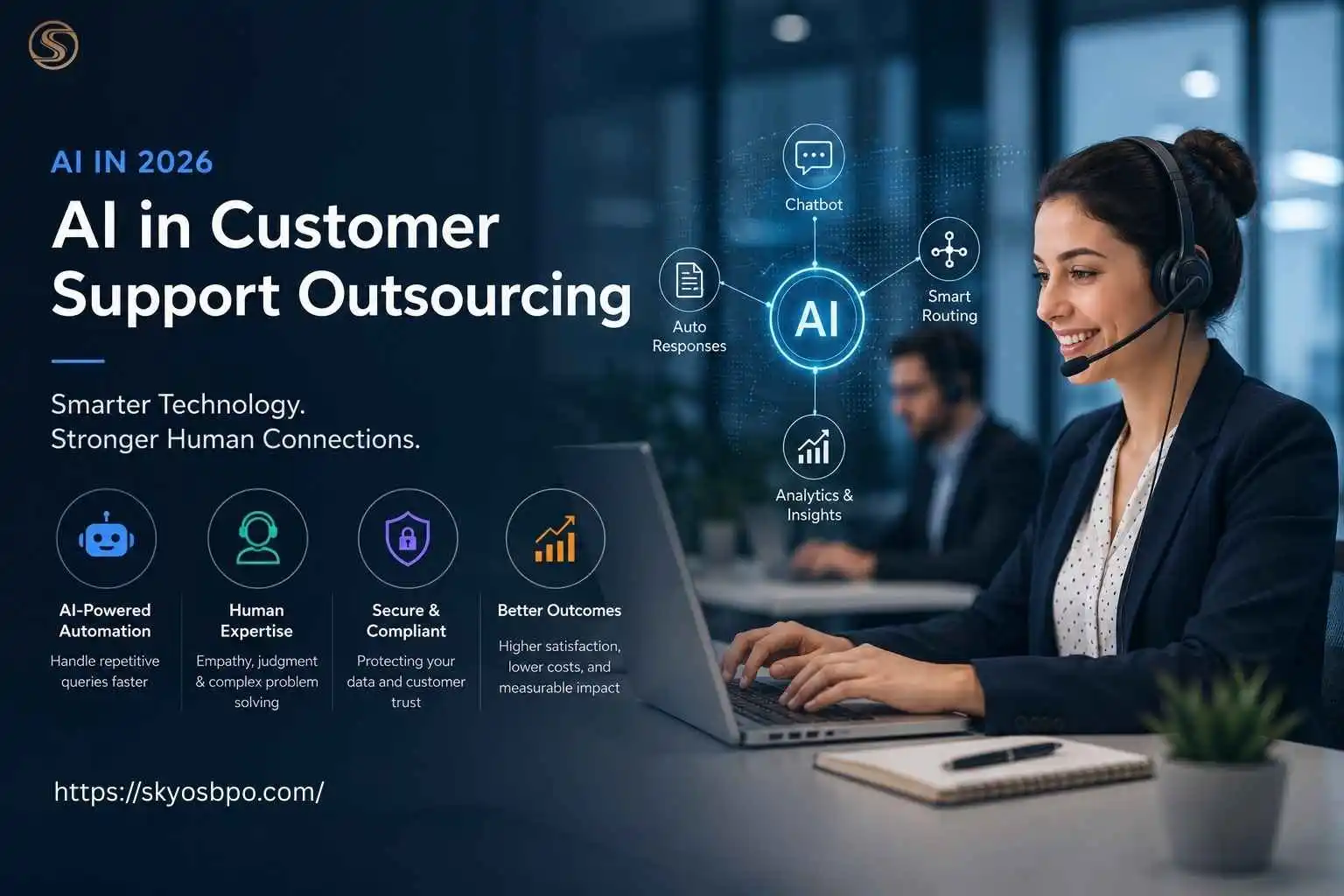
AI is changing customer support outsourcing, but the goal is not simply to replace human agents. The most effective BPO model combines AI for repetitive tasks, intelligent routing, automation, and agent assistance with trained human teams handling complex and sensitive customer interactions. Before choosing a BPO partner, businesses should look beyond the phrase “AI-powered” and ask where AI is actually used, how errors are reviewed, how customer data is protected, and who oversees AI quality. The right partner uses AI to improve support delivery while keeping human accountability at the center of the customer experience.
AI has become one of the most common claims on BPO websites in 2026. Providers increasingly promote AI-powered customer support, automation, and intelligent workflows. But what those claims actually mean varies significantly from one provider to another.
For a business evaluating customer support outsourcing this year, the useful question is no longer "do you use AI." Almost everyone will say yes. The useful question is where, exactly, and what still runs through a person. This article breaks down what AI actually does inside modern BPO services, where it genuinely helps, where it still falls short, and what to ask a provider before you sign anything.
The scale of customer support outsourcing makes this shift commercially important, but businesses should avoid judging the opportunity from a single market-size figure. The more useful question for an individual company is how AI can affect its own support volume, service quality, staffing requirements, response times, and cost per resolution.
For context: the global customer care BPO market is valued at approximately $68 billion in 2026, with projections pointing to $115 billion by 2035 — broader definitions that include voice, digital, and back-office CX work push some estimates above $130 billion. Roughly 66% of BPO providers now use AI tools in active client engagements, per current industry benchmark reporting. That figure matters less as a headline and more as a signal that AI in support delivery is now a baseline expectation, not an experiment.
What Is AI in Customer Support Outsourcing?
AI in customer support outsourcing refers to the use of artificial intelligence within an externally managed customer-service operation. Depending on the business and provider, AI may support customer-facing conversations, ticket classification, routing, knowledge retrieval, response drafting, quality monitoring, agent assistance, or workflow automation.
The important point is that “AI-powered customer support” does not necessarily mean customers are talking to an AI instead of a person. In many effective operating models, AI works behind the scenes while human agents remain responsible for decisions, exceptions, sensitive cases, and conversations that require judgment.
How AI Is Actually Being Used Inside Support Operations Today
Strip away the marketing language and AI shows up in customer support outsourcing in a handful of concrete ways. Gartner estimates AI now handles somewhere close to 40% of first-level customer queries industry-wide, and that share is concentrated almost entirely in a few repeatable jobs. That figure is easy to conflate with a separate, more widely quoted Gartner projection that 75% of all customer interactions will be AI-powered in some form by 2026. The two describe different things: full first-contact resolution by AI versus AI touching some part of the interaction — worth knowing the difference before comparing a provider's numbers against either benchmark.
Chatbots and conversational assistants handle a large share of repetitive, low-complexity queries, including order status requests, password resets, and basic FAQs, without a human touching the ticket at all. Behind the scenes, AI tools route incoming queries to the right queue or specialist based on content and urgency, flag frustrated or high-risk customers through sentiment analysis before a human even opens the ticket, and draft first-pass responses that an agent reviews and sends rather than writing from scratch.
The more advanced version of this, often called agentic AI, goes a step further. Instead of a single scripted response, these systems carry context across an entire conversation, reference previous interactions, and can complete multi-step tasks such as processing a return or updating an account without escalating to a person for every step. As AI adoption increases, more customer interactions are expected to involve AI-assisted workflows at some point in the process, whether the customer notices it or not.
Agentic AI can make an outsourcing workflow more capable, but greater autonomy also increases the importance of permissions, testing, monitoring, and escalation controls. A system that can take action on behalf of a customer should have clearly defined boundaries around what it can access, what it can change, and when it must involve a human.
Channel strategy is moving the same direction. Support in 2026 is increasingly omnichannel and multimodal by default: voice, chat, email, social, and asynchronous messaging feeding into one customer record instead of separate silos, so a customer who starts on chat and calls back an hour later doesn’t have to explain the issue twice. Voice biometrics is also gaining ground for identity verification on phone support, replacing knowledge-based questions that are slow and easy to spoof.
The same shift is happening on the technical support outsourcing side of the business, not just customer-facing chat. AI-assisted triage now helps route incoming IT and SaaS support tickets to the right specialist before a human ever picks them up, which shortens resolution time on the more technical queries that still need a person.
The exact level of human handoff varies by industry, workflow, customer expectations, and the maturity of the AI system. What remains consistent is the importance of designing the handoff deliberately. When a customer needs a person, the agent should receive enough context to continue the conversation rather than forcing the customer to repeat the problem.
The Real Split: AI-Augmented Providers vs. Traditional Labor-Only Providers
This is where the outsourcing market has genuinely divided. One group of providers has built AI into the core of how they deliver work, shaping staffing plans, pricing, and quality control from the ground up. The other group still runs on the traditional model: hire more agents, staff more seats, bill by the hour or the head. Both models still exist, and both can still work depending on what you need.
The mistake buyers make is assuming every provider claiming AI capability belongs in the first group. A chatbot bolted onto an otherwise unchanged call center floor is not the same thing as a support operation genuinely redesigned around AI-assisted delivery. The only way to tell the difference is to ask specific, operational questions rather than accepting a general claim, which is covered further down.
A useful way to evaluate the difference is to look at the workflow rather than the technology label. Ask whether AI affects staffing, routing, knowledge access, quality assurance, reporting, customer interactions, or agent productivity. If the only AI capability is a chatbot placed on the website, the underlying support operation may not have changed very much.
AI Agents vs. AI-Augmented BPOs: A Different Question
A separate comparison is showing up in 2026 procurement conversations: a standalone AI voice or chat agent from a point vendor, versus a BPO that blends AI with trained people. A pure AI agent can work well, and cost less, for a narrow band of high-volume, highly scripted interactions, since it carries no staffing overhead. It tends to struggle the moment a conversation needs judgment or a policy exception, with no human fallback of its own. An AI-augmented BPO covers both ends: automation for the predictable volume, a trained team as the safety net for everything else.
What Customer Support Tasks Should Actually Be Automated?
There is no universal level of automation, and any provider who gives you one without knowing your business is guessing. What matters is the shape of your query volume. Simple, repetitive, low-emotion queries—including order tracking, basic account questions, and standard FAQs—are generally good candidates for full or near-full automation. What makes them safe to automate isn’t just simplicity. It’s that the answer already lives inside a system of record, so an AI tool can retrieve it with high confidence instead of guessing.
Complex, emotionally charged, or account-specific issues are a different story. Billing disputes, service failures, and customers who are already frustrated before they make contact still benefit substantially from human support. Human agents can read tone, make a judgment call, and depart from the script when the situation calls for it. A well-designed support operation in 2026 is not "AI instead of people." It is AI clearing the simple volume so human agents spend their time on the interactions that actually need a human.
A practical automation assessment should consider four things: how predictable the request is, how much risk is involved, whether the necessary information is available to the system, and how costly an incorrect answer would be. A simple FAQ and a sensitive billing dispute should not be treated as equivalent automation opportunities.
Where Human Agents Still Win, and Why They Are Not Going Away
AI is good at pattern matching against a known set of scenarios. It is considerably weaker at situations that fall outside the pattern, an unusual complaint, a customer who needs to be talked down rather than processed, a judgment call about whether to bend a policy for a long-standing client. These are not edge cases you can design away. They are a normal part of running customer support at any real scale.
This is also where brand experience lives. A customer who has a good experience with a thoughtful human agent tends to remember the company, not the technology. A customer routed through three automated menus before reaching a person tends to remember the frustration. The businesses getting the most value from AI in 2026 are the ones using it to protect their agents' time for the interactions that actually need a person, not the ones trying to remove people from the equation entirely.
There’s an operational reason this matters: frontline call center roles run notoriously high turnover, with some industry estimates putting annual attrition at 70 to 100 percent, and every seat that turns over gets re-trained on the client's dime. A hybrid model shrinks that problem, since the highest-turnover, most repetitive volume is exactly what AI now absorbs, leaving a smaller, more experienced human team to retain.
Customer preferences are not uniform. Some customers value fast self-service for simple requests, while others want immediate access to a person when the issue is complicated or sensitive. For that reason, a strong support model should give customers an appropriate path to human assistance rather than forcing every interaction through the same automated experience.
How AI Is Changing BPO Pricing Models
As AI takes on more of the simple volume, some BPO providers are beginning to explore pricing tied more closely to outcomes, such as cost per resolved ticket or successful interaction, rather than relying entirely on hourly or seat-based pricing.
In its more formal version, this shows up as Experience-Level Agreements: contracts that tie payment to customer-experience outcomes such as CSAT or first-contact resolution, instead of headcount or hours logged. Published BPO pricing guides put per-resolution rates in a wide range, roughly $1 to $7, averaging around $4, depending on complexity and geography. It ties a provider’s incentives to the outcome you actually care about, not the number of seats they can bill.
Delivery-model cost benchmarks for 2026 add useful context alongside per-resolution pricing: offshore agents (India, the Philippines, Eastern Europe) typically run $6 to $14 per hour fully loaded; nearshore delivery (Mexico, Colombia, Poland) runs roughly 30 to 50 percent below comparable domestic costs; and domestic agents in the US, UK, or Australia generally range from $22 to $38 per hour. AI augmentation is increasingly priced as a blended layer on top of these figures rather than a separate line item, so ask any provider how AI handling is reflected in their quoted rate.
This connects directly to a point covered in more depth in our guide on how business process outsourcing reduces operational costs: the savings from outsourcing were never just about lower hourly rates, and that is even more true now that AI is part of the delivery mix.
There is no single standard price for AI customer support outsourcing. The actual cost can vary according to ticket volume, support channels, interaction complexity, operating hours, language requirements, technology integrations, security requirements, human staffing, and the level of AI implementation.
When comparing proposals, businesses should look beyond the headline rate and ask what is included. A lower per-ticket price may not represent a lower total cost if it comes with additional technology fees, minimum volumes, implementation charges, or higher escalation costs.
Data Security Risks When AI Is Involved
Every additional AI tool touching customer data is another point where that data is being processed, stored, or analyzed, and that has real compliance implications. If a provider's AI systems interact with customer records, you need to know where that processing happens, whether it complies with GDPR for UK and EU customers or CCPA for US customers, and whether the AI tools themselves are covered under the same data protection agreements as the human team. A provider that has genuinely thought this through will have a clear, specific answer. A provider still figuring it out usually gives a vague one.
Beyond GDPR and CCPA, ask specifically whether the provider's AI vendors (not just the BPO itself) are named in your Data Processing Agreement, and whether customer data used to route or draft responses is retained to train third-party models by default. AI governance should therefore be part of the outsourcing discussion before implementation, not something added after deployment. Businesses should understand which systems process customer information, what permissions those systems have, how data is retained, which vendors have access, and how the provider handles AI-related incidents or incorrect outputs.
It’s also worth asking what security certifications sit under the AI layer itself, not just the BPO’s general operations. SOC 2 Type II and ISO 27001 are becoming baseline credentials for serious providers, and a gap here is worth pressing on before customer data starts flowing through their systems.
How to Evaluate Whether a BPO Provider's AI Capability Is Real
A short list of direct questions gets past the marketing language faster than anything else:- Which specific parts of the workflow does AI actually touch, and which stay fully human?
- What happens when the AI gets something wrong, what is the review and correction process?
- Can they show you real deflection or resolution data, not just a general claim?
- How customer data is handled by the AI tools specifically, and is that covered under the same compliance agreements as the rest of the account?
- Who at the provider actually owns AI quality and oversight, is there a named person, or is it nobody's specific job?
- Does the AI layer carry recognized security certifications such as SOC 2 or ISO 27001, and can they name them specifically rather than pointing to a general compliance page?
- If you need multilingual coverage, are agents native or fluent speakers based in the regions they serve, or is “multilingual” really machine translation layered onto a single-language team?
- What is their trailing-twelve-month agent attrition rate, and does that figure include involuntary departures or only voluntary ones?
One more thing worth asking: what does the provider count as a “resolution”? A high containment rate, the share of interactions closed without a human, looks good on a slide but can hide a customer who gave up rather than got helped. Ask for it alongside CSAT and repeat-contact rate, never alone.
A provider with clear, specific answers to all of these is telling you something true about how they operate. Vague or deflected answers usually mean the AI story is thinner than the sales page suggests.
What This Means for Businesses Choosing a Partner in 2026
This is the model SkyOS BPO runs on for its customer support outsourcing clients: AI-assisted workflows for routing, first-pass drafting, and flagging, combined with real human oversight and a dedicated account manager who knows the account, not a rotating queue. If you are weighing whether to bring in 24/7 customer support or evaluating providers more broadly, our earlier guide on when a business should outsource covers the decision framework in more depth.
If you're specifically comparing providers by location and cost structure, our breakdown of BPO services in Mohali walks through what a Mohali-based, AI-assisted delivery model looks like in practice, useful context alongside the questions in this guide. Worth noting for that comparison: India is also the fastest-growing BPO destination globally in 2026, projected at roughly 14.5% CAGR through 2036, driven largely by its strength in technical, software-adjacent, and AI-augmented support delivery — the same model described throughout this guide.
Conclusion
AI is now standard in customer support outsourcing, but the claim itself means little without specifics. What separates a genuinely AI-augmented BPO from a labor-only provider with a chatbot bolted on is transparency: which workflows AI touches, how errors are corrected, who owns quality, and how customer data is protected. The strongest partners use AI to clear repetitive volume while keeping trained humans accountable for complex, emotional interactions. Ask the right questions before you sign.
The center of gravity in BPO is shifting from labor arbitrage to a mix of intelligent automation, omnichannel delivery, and verifiable security, so the providers worth shortlisting in 2026 are the ones who can speak to all three in specifics, not slogans.
Bring this checklist to your next three provider calls. It takes ten minutes and it's the fastest way to separate a genuine AI-augmented operation from a sales page.
Leave A Comment