

How Business Process Outsourcing Reduces Operational Costs for Businesses in 2026
15
May
- Admin
- 0 Comments
- Last Updated: October 5, 2026
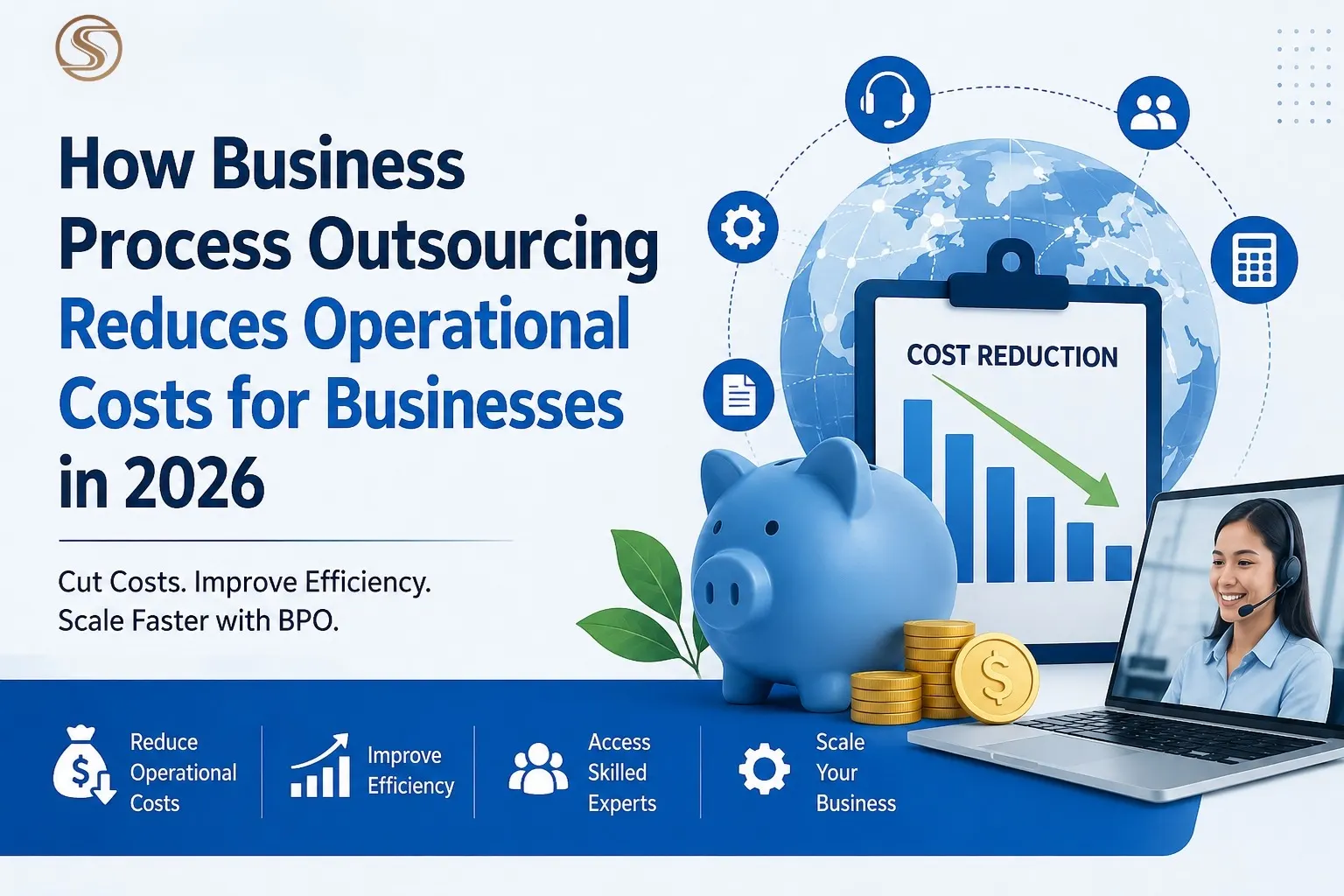
- Business Process Outsourcing (BPO) helps businesses reduce operational costs by outsourcing non-core functions like customer support, payroll, data entry, HR, and back-office operations to specialized service providers. In 2026, companies can save between 20% and 70% on costs through lower payroll expenses, reduced infrastructure investment, better scalability, and access to skilled professionals without full-time hiring costs. India remains the top global BPO destination due to its cost-effective talent, strong infrastructure, and 24/7 service capabilities.
Running a business has never been more expensive. Rising salaries, software costs, compliance requirements, and the pressure to grow with limited resources are squeezing businesses from every direction. Most companies spend a large part of their budget on tasks that are necessary but not strategic. This is where BPO cost reduction becomes a powerful strategy for modern businesses.
That is exactly why business process outsourcing has moved from a cost-cutting tactic to a core growth strategy in 2026. Start-ups, SMEs, and growing enterprises across the world are turning to BPO service providers to reduce overheads, improve efficiency, and compete at a level that was once out of reach.
What is Business Process Outsourcing and How Can It Help?
Business process outsourcing (BPO) is the practice of contracting specific business functions to an external provider rather than managing them internally. In simple terms, outsourcing business processes allows companies to delegate non-core tasks while focusing on growth and strategy. These functions range from customer support and data entry to HR, payroll, billing, and back-office administration.
BPO falls into two broad types. Front-office BPO handles customer-facing work: call centre support, sales assistance, and helpdesks. Back-office BPO manages internal operations: data processing, billing, compliance, record management, and administrative tasks. Both, when outsourced to the right partner, allow a business to operate leaner and at significantly lower cost.
What is BPO Service in India?
India handles an estimated 56% of the world’s total BPO volume, a dominance built on decades of investment in technology, education, and English-language training. BPO service in India delivers a rare combination: a massive pool of skilled professionals who provide expert-level work at a fraction of what the same service costs in North America or Western Europe. Choosing a reliable BPO company in India allows businesses to maximise cost savings while maintaining high-quality service delivery.
India’s time zone advantage enables genuine 24/7 service delivery. The Government’s Digital India initiative has further improved infrastructure across Tier-2 cities like Mohali, Jaipur, and Coimbatore offering even lower operational costs without compromising on talent quality.
What is Business Process Outsourcing in Simple Words?
Instead of hiring, training, and managing a full in-house team to handle your payroll, you hand that function to specialists who do it faster, more accurately, and at a fraction of the cost so your core team can focus entirely on growing the business. That is BPO in its simplest form.
Why Are Operational Costs Rising for Businesses in 2026?
According to Deloitte’s Global Outsourcing Survey, 57% of companies cite cost reduction as their primary reason for turning to BPO, a figure that keeps growing as economic pressures intensify.
Salary benchmarks have risen sharply across most industries. On top of that, software licensing, infrastructure investment, compliance requirements, and the ongoing cost of on-boarding and training new employees are adding up in ways that strain even healthy budgets.
The Hidden Costs of Hiring In-House Teams
When businesses think about the cost of an employee, they usually think of the base salary. But the true cost of a full-time hire is far greater. Factor in:- Recruitment and on boarding fees (typically 15–20% of annual salary)
- Employer contributions: provident fund, insurance, and paid leave
- Office space, equipment, and software per seat
- Training programmes and the 60–90-day productivity dip every new hire brings
The actual cost of a mid-level employee is often 1.5 to 2 times their stated salary. A BPO arrangement replaces that with a clear, predictable service fee, no recruitment cost, no training overhead, and no fixed infrastructure investment. For call center work specifically, see how outsourced call center pricing works.
How Business Process Outsourcing Reduces Operational Costs
The cost savings from BPO are documented and measurable, making it one of the most effective strategies to reduce business costs outsourcing non-core operations to experienced service providers. Here are the four primary mechanisms through which businesses save 20–70% on operational costs.
1. Lower Payroll and Staffing Expenses
Outsourcing converts fixed salary costs into flexible variable costs. You pay for output and capacity not headcount. No recruitment spend, no HR overhead, no benefits administration, no redundancy liability. According to PwC, companies achieve an average 32% reduction in labour costs through outsourcing often from day one.
2. No Infrastructure or Technology Investment Needed
A professional BPO provider brings its own technology stack, software licences, and data infrastructure. The capital expenditure you would otherwise bear on hardware, enterprise software, compliance tools, and secure servers is absorbed into the BPO’s service model. What was a fixed CAPEX becomes a predictable operating expense.
3. Scale Up or Down Without Extra Cost
During a peak season or product launch, you can increase operational capacity within days not months. When demand slows, you scale back with no redundancy costs and no disruption. For startups and SMEs, this on-demand scalability is genuinely transformative.
4. Access to Specialised Expertise at a Fraction of the Cost
Hiring a full-time compliance specialist or senior HR manager is expensive. BPO gives you that exact expertise shared intelligently across the provider’s client portfolio. You get expert-level quality without paying expert-level full-time salaries.
Which Business Functions Should SMEs Outsource First?
Start with the highest-volume, most time-consuming tasks:- 1. Customer Support: High volume and customer-critical — outsourcing ensures professional, round-the-clock handling.
- 2. Data Entry & Back-Office Admin: Time-consuming, accuracy-dependent tasks that consume internal hours without adding strategic value.
- 3. HR Administration & Payroll: Complex, compliance-heavy work that is a natural fit for specialist BPO teams.
- 4. Accounting & Finance Support: Invoice processing, reconciliation, and reporting handled by experts who do this exclusively.
- 5. Technical Support: IT helpdesk and system support that benefits from 24/7 coverage and specialist knowledge.
End-to-End BPO Services for Startups: Grow Without Bloating Your Team
Startups operate where speed is everything and waste is fatal. That is why outsourcing services for startups have become essential for managing operations efficiently without increasing internal costs. The ability to handle customer enquiries, process data, manage finance, and maintain HR without building a large internal team separates successful early-stage companies from those that burn through runway on avoidable overheads.
What Does End-to-End BPO Mean for a Startup?
End-to-end BPO means one partner manages multiple interconnected functions simultaneously customer support, back-office, finance, HR, and data under a single service framework. Instead of piecing together five different vendors, startups work with one provider who handles everything from one place.
For founders, this means spending time on product development, fundraising, and growth not chasing invoices, managing shift rosters, or manually entering customer data. Instead of hiring six people to cover six functions, a startup pays a single service fee and receives professional delivery across all of those areas from day one.
Why Businesses Choose India for Business Process Outsourcing in 2026
India has not held its position as the world’s leading BPO destination for three decades by accident. In 2026, that advantage is stronger than ever. Here is why businesses across the US, UK, Europe, and the Middle East continue to choose India:- 56% of global BPO is managed in India — no other country comes close.
- Over 1.5 million engineering and management graduates enter the workforce every year.
- English-speaking, tech-literate talent at 60% lower cost than Western markets.
- Time zone structure enables seamless overlap for US, UK, and Middle East clients simultaneously.
- The government’s Digital India initiative has expanded broadband and cloud infrastructure nationwide.
- Tier-2 cities like Mohali offer even lower operating costs with high-quality talent pipelines.
For businesses evaluating BPO partners, Mohali represents a compelling case: lower real estate costs, competitive salary benchmarks, strong university pipelines, and proximity to the NCR corridor all within the already cost-efficient Indian BPO landscape.
Conclusion
In 2026, Business Process Outsourcing has become a strategic solution for businesses looking to reduce operational costs, improve efficiency, and scale sustainably. Whether it is BPO cost reduction, outsourcing business processes, or using a trusted BPO company in India, businesses are leveraging outsourcing to stay competitive and profitable. From customer support to back-office operations, BPO enables startups, SMEs, and growing enterprises to focus on core business growth while reducing unnecessary overhead.
Ready to reduce costs and streamline your operations? Connect with our team today at info@skyosbpo.com and discover how SkyOS BPO can support your business growth.
Leave A Comment