

How to Outsource Content Moderation: Costs, Compliance and a Step-by-Step Guide (2026)
27
Oct
- SkyOs BPO Team
- Last Updated: October 27, 2026
- 18 min read
To outsource content moderation, write your rules into a clear policy guide, decide what stays in-house, choose a shared, dedicated or AI + human model, and run a 60 to 90 day pilot with agreed KPIs. An offshore team, for example in India, usually costs much less than an in-house team in the UK or US. Make sure your partner can support the UK Online Safety Act, the EU Digital Services Act and the US 48-hour takedown rule.
Every platform that lets people post something eventually hits the same wall. Comments, images, listings, reviews and videos arrive faster than your team can check them. Harmful posts stay up too long, genuine posts get removed by mistake, and the people doing the reviewing burn out.
Content moderation outsourcing is how many growing platforms solve that problem. This guide explains when it makes sense, what it costs, which laws apply and how to set it up step by step.
What is Content Moderation Outsourcing?
Content moderation outsourcing means hiring an external team to review user-generated content against your platform's rules. That team decides, or helps you decide, whether each post, image, video, profile or listing stays up, comes down, gets restricted or needs escalating.
You keep ownership of the rules. Your partner supplies the trained reviewers, shift cover, quality checks and reporting. If you are new to the topic, our guide on what content moderation is covers the basics.
Is Outsourcing Content Moderation Right for Your Platform?
There is no magic user count. It comes down to volume, coverage and how much risk sits in your queue.
| Good fit | Not a good fit (yet) |
|---|---|
| Your report queue never clears, especially overnight and at weekends | You review fewer than a few hundred items a week |
| Your users are spread across time zones and need 24/7 cover | Your community rules are still changing every week |
| You are launching in new markets or languages | You have no written policy guide yet |
| Sales events, launches or live events cause sharp spikes | Almost all of your queue is sensitive legal or child safety escalations |
| Product, support or policy staff are pulled into reviewing | You cannot share access to your moderation tools |
Low volume is the most common reason outsourcing disappoints. A partner needs enough steady work to keep reviewers trained and accurate.
If your rules are still in flux, spend a month writing them down first. Outsourcing an unclear policy simply means paying someone else to guess.
In-House vs Outsourced Content Moderation: Which is Better?
Most growing platforms end up with a mix: policy and sensitive escalations stay in-house, and high-volume review is outsourced.
| Factor | In-house team | Outsourced team |
|---|---|---|
| Time to launch | 1 to 3 months to recruit, train and set up tooling | A few weeks, once policies and tools are ready |
| Cost | Salaries, benefits, office space, managers and wellbeing support | One rate covering reviewers, supervision, QA and facilities |
| 24/7 coverage | Expensive night and weekend shifts | Usually built into the service |
| Scaling up or down | Slow hiring and hard to reduce | Add or remove reviewers with notice |
| Policy knowledge | Deep from day one | Built through training and calibration |
| Control | Direct | Through SLAs, reporting and regular reviews |
| Languages | Limited to who you can hire locally | Easier to add native reviewers |
| Data security | Fully under your control | Depends on the partner's controls and contract |
Security is the factor most teams worry about, and rightly so. Our checklist for choosing a secure BPO partner covers the controls to look for.
What to Outsource and What to Keep In-House
Most outsourcing problems start with a fuzzy scope. Before you talk to any provider, decide which work moves out, which stays with you, and what each side is accountable for.
| Work | Good fit for outsourcing? | What to agree in the contract |
|---|---|---|
| First-line review of comments, images, listings and reviews | Yes, this is the core of most contracts | Your policy guide, an accuracy target and a turnaround time |
| Video and live streams | Yes, with experienced reviewers | Exposure limits and a real-time escalation path |
| User reports and appeals | Yes | Response times, and who makes the final call on an appeal |
| Intimate image removal requests (US) | Yes, as a dedicated queue | The 48-hour clock, cover every day of the year, and the search for duplicate copies |
| Child abuse and terrorist content | Detection and first review, yes | Who reports it to the authorities (the NCA in the UK, NCMEC in the US) and how quickly |
| Writing and changing policy | No, keep it in-house | Your partner flags gaps and edge cases every week |
| Law enforcement requests and regulator contact | No | Your partner passes these straight to your team |
| Transparency reporting | Partly | Your partner records the data for every decision; you publish the report |
If a provider is happy to take on everything, including your policy decisions, be cautious. Your platform carries the legal risk, so the judgement calls that shape your rules should stay with you.
Content Moderation Outsourcing Models: Shared, Dedicated or AI + Human?
The model you choose affects cost, accuracy and how well reviewers learn your platform.
Shared Team
Reviewers split their time between several clients.
- Pros: lowest cost, quick to start, no minimum team size.
- Cons: less platform knowledge, slower to adapt when your rules change.
- Best for: simple, rules-based queues such as spam, reviews or listing checks.
Dedicated Team
Reviewers work only on your platform, inside your tools.
- Pros: deep knowledge of your policies, higher accuracy on grey-area content, easier calibration.
- Cons: higher monthly cost, usually a minimum team size.
- Best for: social apps, communities and any platform with nuanced or high-risk content.
AI Screening + Human Review
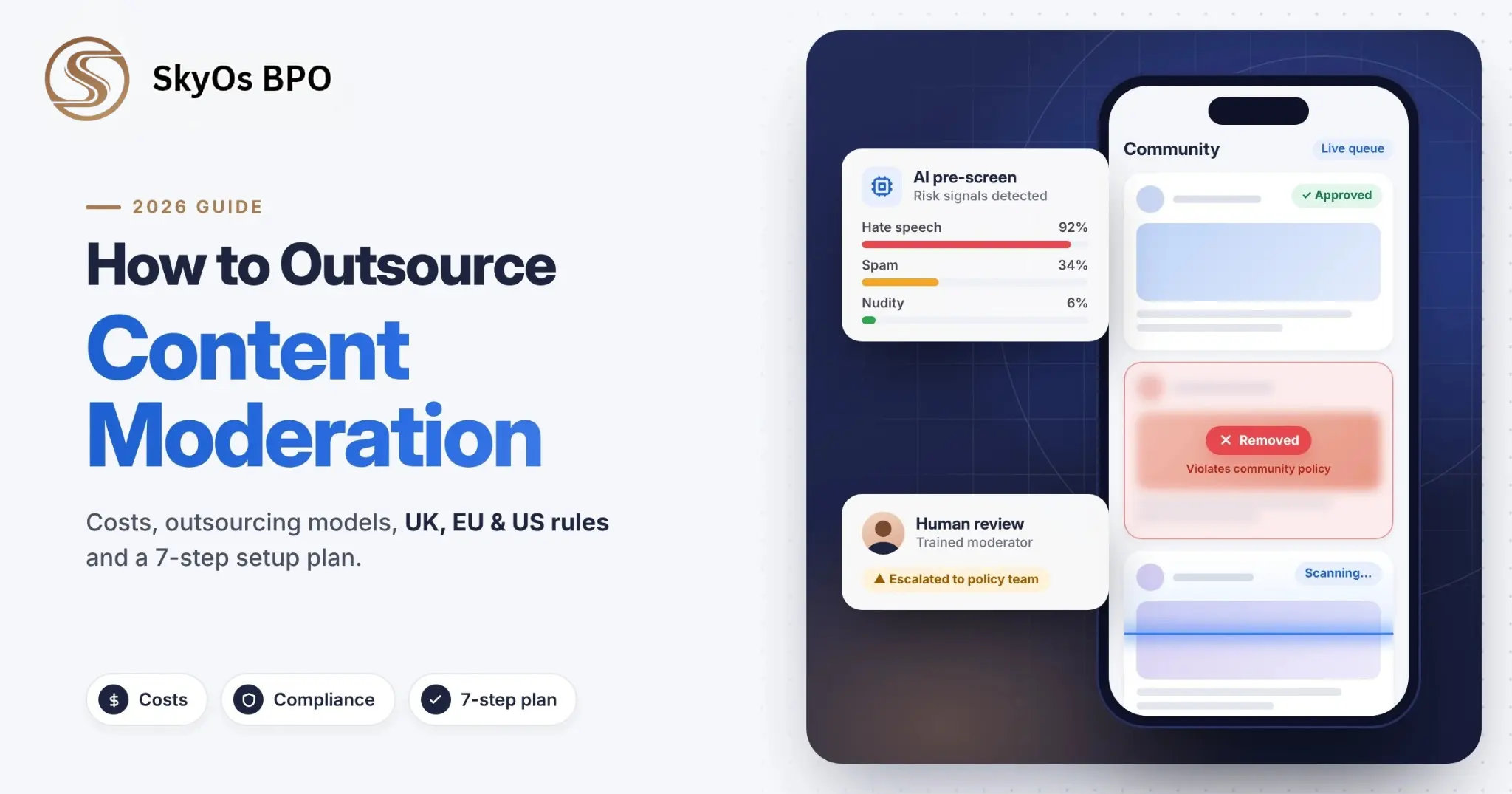
Automated filters score every item. Clear violations are removed and clearly safe content goes live. Anything uncertain, sensitive or reported by users goes to trained reviewers.
- Pros: handles very high volumes, cuts cost per item, faster response.
- Cons: filters miss sarcasm, slang and cultural context, and need constant tuning.
- Best for: large platforms where most content is low risk.
In this model, agree in writing who owns each layer. Usually you or your tool vendor own the filters, your partner owns first human review, and anything legal or high-profile escalates to your team. Also agree who can change the confidence thresholds that decide what reaches a human, because moving them changes your volumes and costs overnight. For background on how automated and human review compare, see what content moderation is.
Which Model Fits You?
| Your situation | Best model |
|---|---|
| Low volume, simple rules | Shared team |
| Nuanced content, brand-sensitive community | Dedicated team |
| Very high volume, mostly low-risk content | AI screening + human review |
| Several languages or markets | Dedicated team with native reviewers |
| Seasonal spikes on top of steady volume | Dedicated core team plus shared overflow |
How Much Does It Cost to Outsource Content Moderation?
Prices vary widely. The same moderator can cost significantly more or less depending on location, language, content type and the hours you need covered. For wider context, Clutch's pricing data shows that the average hourly rate of content moderation providers listed in India is under $25.
| Pricing model | How you are billed | Best for |
|---|---|---|
| Per moderator hour | An hourly rate for each reviewer's time | Shared teams and flexible volumes |
| Dedicated moderator (monthly) | A fixed monthly fee for each full-time reviewer | Steady volume and nuanced policies |
| Per item | A fee for each piece of content reviewed | Simple, predictable checks such as listings or images |
| Tiered volume | A per-item rate that drops as volume rises | Large platforms with high, steady volumes |
| Outcome-based | Pricing linked to SLAs or accuracy targets | Mature programmes with clear metrics |
Per-item pricing looks simple, but it can reward speed over care. For anything that needs judgement, a dedicated team with clear quality targets usually performs better.
Three Cost Examples (Illustrative Numbers)
These examples use an illustrative rate of $10 per moderator hour so the maths is easy to follow. Your real rate will depend on your provider and requirements.
| Situation | What you need | How it is calculated | Estimated monthly cost |
|---|---|---|---|
| Small marketplace checking listings | 2 reviewers, 8 hours a day, weekdays | 2 × 160 hours × $10 | $3,200 |
| Growing social app | 1 reviewer on shift 16 hours a day, 7 days a week | 112 hours a week × 4.33 weeks × $10 | About $4,850 (roughly 3 full-time reviewers) |
| Large platform with 24/7 cover | 3 reviewers on shift around the clock | 504 hours a week × 4.33 weeks × $10 | About $21,820 (roughly 14 full-time reviewers) |
The 24/7 example shows why round-the-clock cover is a big step up. A week has 168 hours, and one full-time reviewer covers about 40 of them, so every seat you keep open around the clock needs four to five people behind it.
What Affects the Price
- Content type. Text is the quickest to review. Video, live streams and graphic content take longer and need more reviewer support.
- Languages. Common languages cost less than rare ones or native-level review in several markets.
- Coverage hours. Night, weekend and holiday shifts all add cost.
- Turnaround targets. Reviewing within minutes needs more people on shift than reviewing within 24 hours.
- Accuracy and QA. Higher accuracy targets mean more second reviews and calibration sessions.
- Tooling. Working inside your tools is usually cheaper than paying for a partner's platform licence.
Hidden Costs to Ask About
- Training time for new reviewers and every policy change
- Minimum team sizes or minimum contract terms
- Set-up fees and tool licences
- Overtime charges during spikes
- High reviewer turnover, which means constant retraining and lower accuracy
For a closer look at how outsourcing contracts are priced, read our guide to call center outsourcing pricing models.
How Many Moderators Do You Need?
You can get a reliable first estimate with three numbers: how many items need human review each day, how long each one takes, and how many productive hours a reviewer works.
Worked example. Your platform sends 20,000 items a day to human review. Each takes 30 seconds on average. Each reviewer has 6 productive hours a shift, after breaks, training and wellbeing time.
- Daily review time: 20,000 × 30 = 600,000 seconds
- Productive time per reviewer: 6 × 3,600 = 21,600 seconds
- Reviewers needed each day: 600,000 ÷ 21,600 = 27.8, so 28
- Seven-day cover, with each person working five days: 27.8 × 7 ÷ 5 = 38.9
- Add a 20% buffer for leave, sickness and spikes: 38.9 × 1.2 = 46.7, so about 47 reviewers in total
Two things change this number quickly. Graphic content needs shorter exposure periods and more breaks, so productive hours drop. And peak hours matter more than daily totals: if half your reports arrive in a four-hour window, you need more people on that shift. A good partner will model this with you using your real data.
How to Outsource Content Moderation in 7 Steps
Follow these steps in order. Skipping the early ones is the main reason pilots fail.
1. Write Your Policy Guide
Turn your community guidelines into a decision guide. For each rule, give clear examples of content that is allowed, removed, restricted or escalated. Reviewers can only be as consistent as your policy is clear.
2. Measure Your Volume and Peak Hours
Pull at least four weeks of data: items reviewed per day, the busiest hours, the mix of content types and your current turnaround times. This is what your partner will use to size the team.
3. Decide What Stays In-House
Keep policy ownership, legal escalations and contact with law enforcement and regulators. Hand over the volume.
4. Choose Your Model
Pick shared, dedicated or AI + human review using the table above. If you are unsure, a small dedicated team is the safest place to start.
5. Shortlist and Check Providers
Compare two or three providers using the checklist below. Ask for references, check certificates and, if you can, visit the delivery centre.
6. Run a 60 to 90 Day Pilot
Start with one queue or content type. Agree the KPIs, targets and reporting before day one, so both sides know what success looks like.
7. Calibrate Weekly, Then Scale
Each week, have your policy team and the partner's reviewers decide the same sample of tricky cases and compare results. Once accuracy and turnaround hit target for a few weeks in a row, add more queues, languages or hours.
Tip: read a sample of real decisions every week, not just the dashboard. The numbers tell you how fast reviewers are working. The decisions tell you whether they understand your platform.
UK, EU and US Rules Your Moderation Partner Must Understand
Outsourcing the work does not outsource the legal responsibility. Your platform stays accountable, so your partner's processes need to support your compliance. This is a summary as of October 2026, not legal advice.
UK: Online Safety Act
The Online Safety Act applies to user-to-user services, such as social apps, forums, marketplaces and gaming chats, and to search services. It is enforced by Ofcom.
| Date | What applies |
|---|---|
| 17 March 2025 | Illegal content safety duties, under Ofcom's illegal harms codes of practice |
| 25 July 2025 | Children's safety duties for services likely to be accessed by children |
| 7 April 2026 | Duty to report detected child sexual exploitation and abuse content to the National Crime Agency |
| From July 2026 | Extra duties for the largest "categorised" services, once listed on Ofcom's register |
Dates are from Ofcom's compliance timeline. Ofcom can fine a company up to £18 million or 10% of global revenue, whichever is greater, according to the House of Commons Library.
For your moderation partner, this means fast removal of illegal content once you are aware of it, clear escalation routes for child safety material, and decision records you can use in your risk assessments.
EU: Digital Services Act
The Digital Services Act has applied to all online intermediaries serving EU users since 17 February 2024. Hosting services and online platforms must:
- run a notice-and-action system so people can report illegal content
- give users a clear "statement of reasons" when their content is removed or restricted
- offer an internal complaints process so users can appeal
- publish transparency information about their moderation
Fines can reach 6% of global annual turnover. In practice, your partner must record why each decision was made, in a form you can turn into statements of reasons and transparency reports.
US: The TAKE IT DOWN Act
The TAKE IT DOWN Act's removal duties took effect on 19 May 2026. According to the FTC's compliance guidance, covered platforms must:
- remove reported non-consensual intimate images, including AI-generated fakes, within 48 hours of a valid request
- make reasonable efforts to remove known identical copies within the same 48 hours
- offer a clear, easy request process, open to people without an account
The FTC enforces the Act, and violations can lead to civil penalties of $53,088 per violation. If your platform hosts user images or video, your partner needs a dedicated queue and shift cover that can meet that 48-hour clock every day of the year.
If children under 13 may use your US service, the Children's Online Privacy Protection Act (COPPA) also limits how you collect and handle their personal data. Your moderators will often be the first to spot underage accounts, so agree how they flag them.
Data Protection When Moderating from India
Moderation means your partner sees personal data. For UK and EU users, that puts UK GDPR or EU GDPR in play:
- Sign a data processing agreement that sets out what your partner can access and why.
- Sending UK personal data to India is a restricted transfer. Use an approved safeguard, such as the UK International Data Transfer Agreement or the UK Addendum to the EU standard contractual clauses, and check the ICO's current guidance.
- Ask for role-based access, no personal devices on the review floor, logged access and secure deletion.
Ask for evidence rather than promises: signed confidentiality agreements for every reviewer, regular access reviews, and a clear plan for what happens to your data when the contract ends.
How to Choose a Content Moderation Outsourcing Provider
Most providers promise quality, security and scale. Use this checklist to compare them on evidence rather than claims.
| What to check | What good looks like |
|---|---|
| Accuracy measurement | A clear QA method, with regular sampling and second reviews |
| Calibration | Weekly sessions where reviewers and your policy team compare decisions |
| Certifications | Current certificates that cover the delivery centre doing your work, with the scope and expiry date shown |
| Data protection | A data processing agreement, role-based access and a secure review floor |
| Coverage | Proven cover for your peak hours, weekends and public holidays |
| Scalability | A plan for adding reviewers during spikes, with notice periods in writing |
| Languages | Native or fluent reviewers for each market you serve |
| Tools | Willing to work inside your moderation tools and alongside your filters |
| Reviewer wellbeing | A written programme with exposure limits, breaks and counselling |
| Pricing | One written proposal covering training, set-up, minimums and overtime |
If a provider cannot show evidence for most of these, keep looking. The cheapest quote rarely stays the cheapest once rework, retraining and missed deadlines are counted.
Moderator Wellbeing: Why It Affects Your Results
Moderator wellbeing is sometimes treated as an HR topic. It is also a quality topic. Reviewers who are exhausted or distressed make more mistakes, take more sick leave and leave sooner, and every departure means retraining someone on your policies.
The research is clear about the risk. A 2025 Middlesex University study surveyed 160 content moderators and found that:
- just over a quarter showed moderate to severe psychological distress
- about a third reported low wellbeing
- 76.9% had been exposed to hate speech and 34.4% to child sexual abuse material
- 28.7% saw distressing content every day
The same study found that structured meetings after distressing incidents were linked to lower stress and better wellbeing, and that support works best when it is tailored rather than one-size-fits-all.
What Good Providers Do
- Limit continuous exposure to graphic content, with planned rotation between queues
- Use tools that blur, greyscale or mute graphic content until a reviewer chooses to view it
- Build mandatory breaks into every shift
- Offer confidential counselling and structured debriefs after distressing cases
- Let reviewers opt out of the most severe queues without penalty
- Screen and prepare new reviewers honestly about what the work involves
Ask to see a partner's wellbeing programme in writing. If they cannot describe one, treat that as a warning about quality as well as ethics.
Risks of Outsourcing Content Moderation and How to Avoid Them
| Risk | How to avoid it |
|---|---|
| Inconsistent decisions | A detailed policy guide with examples, plus weekly calibration |
| Missed legal deadlines | Time-critical queues with their own SLAs and 365-day cover |
| Data leaks | A data processing agreement, role-based access and no personal devices on the review floor |
| High reviewer turnover | A real wellbeing programme and exposure limits for graphic content |
| Loss of control over policy | Keep policy ownership and final appeal decisions in-house |
| Hidden costs | A written proposal that lists training, set-up, minimums and overtime |
| Vendor lock-in | Work inside your own tools and keep your decision data in your systems |
Most of these risks come back to the same root causes: unclear policies and a vague contract. Fix both before the pilot starts and the rest becomes much easier to manage.
Which KPIs Should You Track for Outsourced Content Moderation?
Agree these before the pilot starts, so both sides know what good looks like.
| KPI | What it tells you | Suggested starting target |
|---|---|---|
| Decision accuracy | How often decisions match your policy, checked by QA sampling | 95% or higher |
| False positive rate | How much legitimate content is wrongly removed | Falling month on month |
| False negative rate | How much violating content is wrongly left up | Falling month on month |
| SLA compliance | How many items are handled within the agreed time | 95% or higher |
| Time-critical takedowns | Whether legal deadlines, such as 48 hours in the US, are met | 100% |
| Appeal overturn rate | How many appealed decisions get reversed | Low and stable |
| Calibration agreement | How consistently reviewers decide the same test cases | 90% or higher |
| Queue backlog | Items still waiting at the end of each shift | Close to zero |
Treat these targets as a starting point and adjust them to your platform. Watch false positives and false negatives together, because pushing one down often pushes the other up.
Conclusion
Outsourcing content moderation works when you treat it as a partnership, not a hand-off. Write clear policies, keep legal judgement in-house, start with a pilot and read real decisions every week.
Choose the model that matches your volume and risk, budget honestly for the hours you need covered, and make sure your partner can meet the deadlines that the UK, EU and US now set. Compare providers on evidence, from accuracy and security to reviewer wellbeing, rather than on the hourly rate alone.
If you are still building your understanding of the topic, our guides on what content moderation is and why content moderation matters in 2026 are a good next read.
Frequently Asked Questions
1. How Much Does Content Moderation Outsourcing Cost?
It depends on the content type, languages, coverage hours, turnaround targets and accuracy you need. Most providers charge per moderator hour or per item reviewed. Offshore moderation, for example from India, usually costs far less than building an in-house team in the UK or US. Ask for a written quote that includes training, set-up and any minimum terms.
2. Can AI Fully Replace Human Content Moderators?
Not yet. AI handles volume and obvious violations well, but it struggles with context, sarcasm, new slang, cultural nuance and appeals. Most platforms use AI for first-pass screening and trained people for anything uncertain, sensitive or disputed.
3. Is It Safe to Outsource Content Moderation to India?
It can be, if the partner has the right controls. Check for a signed data processing agreement, an approved safeguard for UK or EU data transfers, role-based access, a secure review floor and recognised certifications. Visit the delivery centre if you can.
4. Does the UK Online Safety Act Apply to My Business?
It applies to services that let users share content with each other, and to search services, where those services have links to the UK, such as a significant number of UK users. Illegal content duties have applied since 17 March 2025. Check Ofcom's guidance or take legal advice for your specific service.
5. How Do Outsourced Moderators Learn Our Platform's Rules?
Through your written policies, worked examples, supervised practice on real content and regular calibration sessions where reviewers compare decisions on the same cases. Expect accuracy to rise steadily over the first few weeks of a pilot.
6. Can Outsourced Moderators Work in Our Existing Tools?
Usually, yes. Most experienced partners work inside the client's moderation platform, help desk or admin panel, which keeps your data in one place and your reporting consistent.
7. How Quickly Can an Outsourced Moderation Team Start?
It depends on team size, languages and how ready your policies are. A small team for one queue can often start within a few weeks. Larger, multilingual or 24/7 teams take longer to recruit and train.

SkyOs BPO Team
The SkyOS BPO Team is a group of outsourcing specialists delivering end-to-end solutions across customer support, healthcare BPO, finance & accounting, data entry and processing, IT services, and back-office operations. We partner with global organizations to improve efficiency, maintain compliance, and drive sustainable growth.
Leave A Comment