

Medical Billing Outsourcing: Complete Guide for Clinics and Hospitals
15
Apr
- SkyOs BPO Team
- Last Updated: November 17, 2026
- 6 min read
Healthcare providers in 2026 are facing increasing pressure to manage complex billing systems while maintaining high-quality patient care. As administrative workloads grow, many clinics and hospitals are turning to medical billing outsourcing to improve efficiency and reduce operational stress.
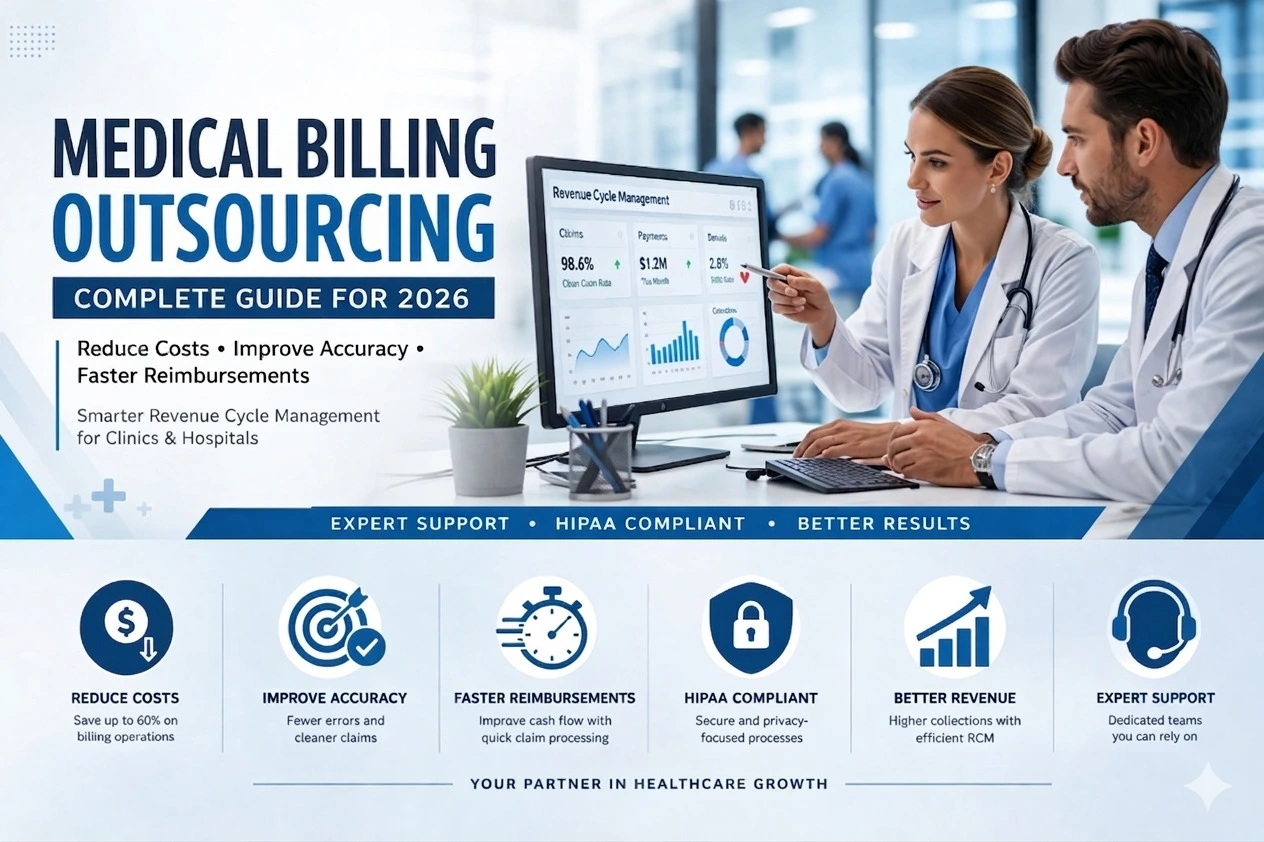
By outsourcing billing processes, healthcare outsourcing providers can streamline their revenue cycle management (RCM), reduce errors, and accelerate reimbursements. In this guide, you’ll learn how medical billing outsourcing works, its benefits, costs, risks, and how to choose the right partner.
What Is Medical Billing Outsourcing?
Medical billing outsourcing is the process of hiring a third-party company to manage billing, coding, and insurance claims for healthcare providers. It works by transferring revenue cycle tasks such as claim submission and follow-ups to specialists. Healthcare providers use it to reduce costs, improve accuracy, and speed up reimbursements.
Why Medical Billing Outsourcing Is Growing in 2026
The demand for medical billing outsourcing services is rising due to increasing administrative complexity and stricter healthcare regulations. The global market, valued at USD 18.20 billion in 2025, is projected to reach USD 50.47 billion by 2034, growing at a CAGR of 12.05%.
Cost efficiency is another major driver. Practices spend around 13.7% of their collections on in-house billing compared to just 5.4% when outsourcing. At the same time, over 60% of practices have reported rising claim denials, making professional claim denial management essential for maintaining steady revenue.
Common Billing Problems Outsourcing Solves
Healthcare billing is time-sensitive. A missed deadline, a wrong code or incomplete documentation can delay payment by weeks or even months. The problems we see most often in clinics and hospitals are:- Claims denied because of small, avoidable errors
- Delayed reimbursements that make income unpredictable
- Staff spending hours on follow-ups instead of patient care, which leads to burnout
- Poor visibility into outstanding payments and patient balances
These problems rarely fix themselves. They tend to grow quietly until cash flow becomes a serious concern. That is usually the point where practices start looking for professional medical billing support.
How Medical Billing Outsourcing Works
Step 1 — Patient Registration and Insurance VerificationAccurate patient data is collected and insurance eligibility is verified. This step reduces errors at the start of the revenue cycle management (RCM) process.
Step 2 — Medical Coding (ICD-10, CPT, HCPCS)Certified coders assign standardized codes such as ICD-10, CPT, and HCPCS. Many providers rely on medical coding outsourcing to ensure compliance and accuracy.
Step 3 — Claim SubmissionClaims are prepared and submitted electronically to insurance companies. Clean claims improve approval rates and reduce delays.
Step 4 — Denial Management and Follow-UpDenied claims are corrected and resubmitted quickly. Strong claim denial management helps recover lost revenue.
Step 5 — Payment Posting and ReportingPayments are recorded and reports are generated. This provides full visibility into financial performance.
Key Benefits of Outsourcing Medical Billing
- Significant Cost Reduction: Outsourcing reduces billing costs from 13.7% to around 5.4% of collections, making medical billing outsourcing highly cost-effective.
- Fewer Claim Denials: Advanced validation tools and expert review reduce errors before submission, lowering rejection rates.
- Faster Reimbursement Cycles: Dedicated teams follow up on claims quickly, improving cash flow and reducing delays.
- HIPAA Compliance and Regulatory Coverage: Providers ensure HIPAA compliant billing and stay updated with regulations, reducing compliance risks.
- Focus on Patient Care: Staff can focus on patient care instead of administrative tasks, improving overall service quality.
- Scalability: Outsourcing easily adapts to growing patient volumes without increasing internal workload.
- Stable, Predictable Cash Flow: Rent, salaries and supplies all depend on regular income. When claims are submitted and followed up consistently, payments arrive more regularly and you can see exactly what is still outstanding.
Which Clinics and Hospitals Benefit Most from Medical Billing Outsourcing
- Small and Independent Clinics: Outsourcing eliminates the need for in-house billing staff. Medical billing for clinics becomes more affordable and efficient.
- Multi-Specialty Practices: Complex billing across specialties is handled with accuracy and consistency.
- Large Hospital Systems: Medical billing for hospitals improves efficiency and supports high claim volumes.
- Rural and Standalone Practices: Outsourcing provides expert support without requiring additional infrastructure.
In-House Medical Billing vs Outsourcing: What Is the Difference?
In-house billing requires hiring staff, investing in software, and managing compliance internally, which increases costs and workload. Outsourcing provides access to experienced professionals and advanced tools at a lower cost.
| Aspect | In-House Billing | Outsourced Medical Billing |
| Staffing | You hire and train billing staff | No internal hiring needed |
| Rule and code updates | Your staff must track every change | Managed by billing specialists |
| Cost | Fixed salaries, software and overhead | Predictable service fee |
| Focus | Billing competes with other duties | A dedicated billing team |
| Scaling | Hire more staff as volume grows | Capacity adjusts to your volume |
Outsourced billing improves accuracy, reduces denial rates, and offers better scalability. Compared to in-house vs outsourced billing, outsourcing delivers higher efficiency and more predictable revenue outcomes.
Our Experience With Healthcare Billing
At SkyOs BPO, we have seen that most healthcare providers do not struggle because they lack effort. They struggle because billing needs specialist attention, and payer rules and compliance requirements keep changing.
Our billing teams work in a structured way: they follow updated payer guidelines, track how each payer behaves, keep detailed records and run regular audits. This level of focus is hard to achieve when billing is handled alongside reception, scheduling and other duties. Over time, this structured support helps providers regain clarity and control over their revenue cycle.
How to Choose the Right Medical Billing Outsourcing Company
Check Certification and HIPAA ComplianceChoose a provider that ensures HIPAA compliant billing and employs certified experts.
Ask About Denial Rates and Claim AcceptanceLook for providers with high first-pass acceptance and low denial rates.
Confirm EHR and EMR IntegrationEnsure compatibility with your existing systems for smooth workflow.
Understand the Pricing ModelSelect a pricing structure that aligns with your revenue goals.
Request Client ReferencesCheck case studies or testimonials from similar healthcare providers.
Potential Risks of Medical Billing Outsourcing and How to Avoid Them
- Data security and patient privacy: Work with providers that follow strict data protection standards.
- Loss of control and visibility: Choose partners that offer transparent reporting and real-time dashboards.
- Choosing the wrong provider: Evaluate experience, certifications, and client feedback carefully.
Is Medical Billing Outsourcing Right for Your Practice?
Medical billing outsourcing is a smart strategy for healthcare providers aiming to reduce costs, improve efficiency, and simplify operations in 2026. It helps streamline billing processes while ensuring compliance and accuracy.
As practices grow, billing gets more complex: more patients mean more claims, more payers and more follow-ups. Outsourcing lets you grow without rebuilding your billing system every time volume increases, which is especially useful for multi-location practices and providers adding new services.
Whether you run a clinic or a hospital, outsourcing allows you to scale operations, improve cash flow, and reduce administrative burden. Most importantly, it enables your team to focus on delivering better patient care.
If you're ready to optimize your billing process, SkyOs BPO offers reliable and scalable healthcare BPO services tailored to your needs. Get a free consultation today at info@skyosbpo.com
Frequently Asked Questions
What is medical billing outsourcing?
Medical billing outsourcing is the process of hiring a third-party provider to manage billing, coding, and insurance claims for healthcare services.
How much does medical billing outsourcing cost?
It typically costs between 4% and 9% of total collections, depending on the provider and services offered.
Is medical billing outsourcing safe?
Yes, it is safe when the provider follows HIPAA compliance and uses secure data protection systems.
What is the difference between medical billing and coding?
Medical coding converts healthcare services into standardized codes, while billing focuses on claim submission and payment collection.
How long does it take to set up outsourced medical billing?
The setup process usually takes between 2 to 6 weeks, depending on system integration and data migration.
Can small clinics afford medical billing outsourcing?
Yes, outsourcing is often more cost-effective than maintaining an in-house billing team.
What services are included in medical billing outsourcing?
Services typically include medical coding, claim submission, denial management, payment posting, and reporting.
How does outsourcing reduce claim denials?
Outsourcing reduces denials by using expert coders and validation tools to identify and fix errors before claim submission.
How does healthcare billing affect cash flow?
Accurate, on-time billing means insurance payments arrive regularly, which covers day-to-day costs like salaries, rent and supplies. Errors and late follow-ups delay payments by weeks and make income unpredictable.

SkyOs BPO Team
The SkyOS BPO Team is a group of outsourcing specialists delivering end-to-end solutions across customer support, healthcare BPO, finance & accounting, data entry and processing, IT services, and back-office operations. We partner with global organizations to improve efficiency, maintain compliance, and drive sustainable growth.
Leave A Comment