

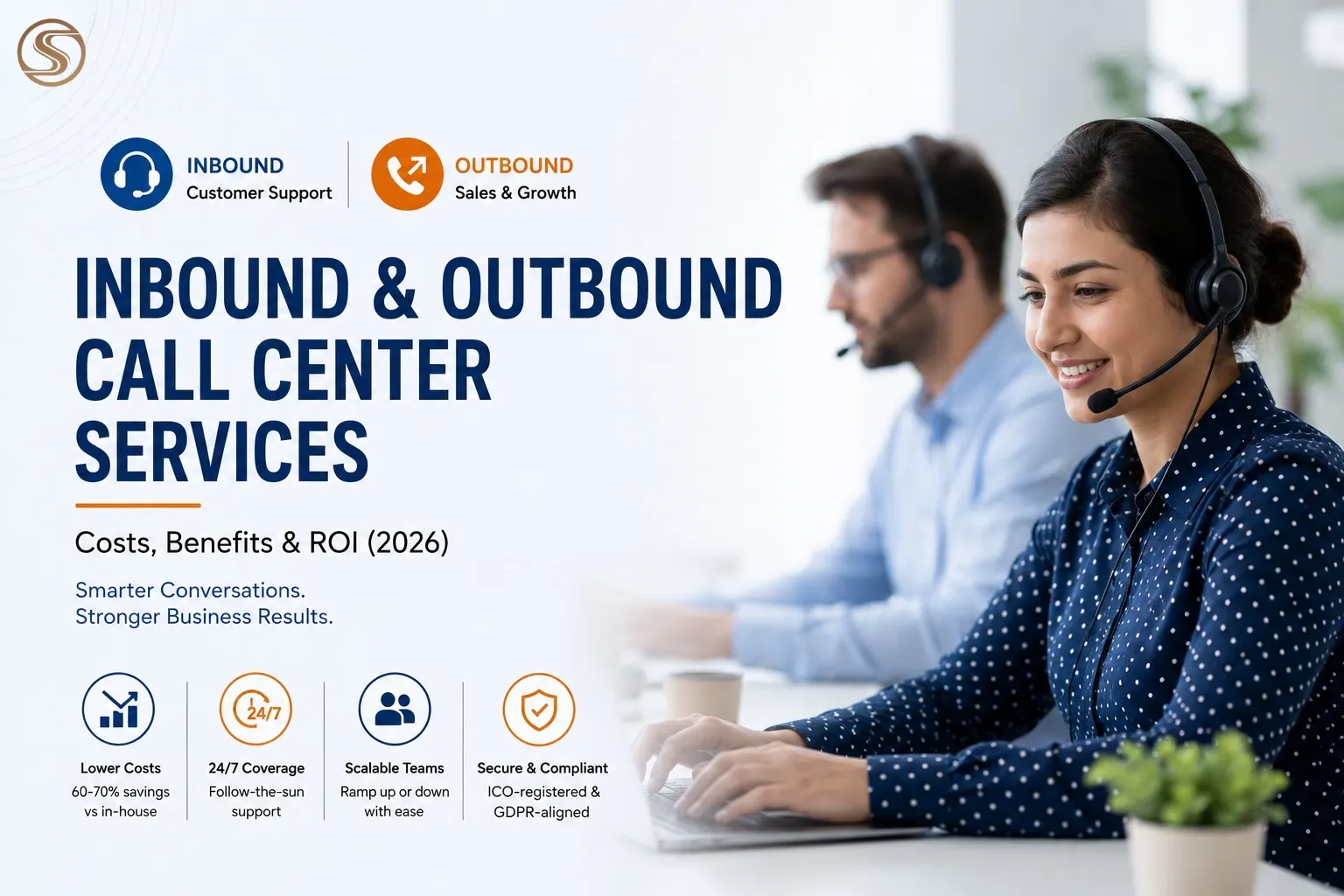
Inbound and Outbound Call Center Services: Costs, Benefits & ROI (2026)
29
Jul
- Admin
- 0 Comments
- Last Updated: October 5, 2026
- What it is: Inbound call center services handle calls customers make to you; outbound call center services handle calls your team makes to customers and prospects.
- Cost advantage: Outsourcing both functions typically cuts operational costs by 60 to 70 percent versus building equivalent in-house teams in the UK or US.
- Coverage: India-based follow-the-sun delivery covers UK and US hours without night-shift premiums.
- Best for: UK, US, and Canadian SMEs that need dedicated support and sales-calling capacity without a multi-month hiring cycle.
- → Inbound call centers protect customer satisfaction and retention through fast, trained support.
- → Outbound call centers drive pipeline and revenue through proactive, compliant calling.
- → Outsourcing both typically costs 60 to 70 percent less than in-house UK or US teams (Grand View Research, Deloitte).
- → Go-live for a dedicated inbound and outbound team runs two to four weeks with a structured BPO partner.
- → SkyOS BPO delivers both functions from a single Mohali-based, GDPR-aligned, ICO-registered operation.
Is your support team drowning in call volume while your sales team is stuck making follow-up calls it doesn't have time for? That is the exact tension inbound and outbound call center services exist to solve, and most growing businesses are running both functions badly before they realize the two need entirely different setups.
Here is the reality most businesses face. A customer calls in with a billing question and waits eleven minutes on hold. Meanwhile, three qualified leads from last week's campaign still have not received a follow-up call, because the same small team is handling both jobs. The support ticket eventually gets resolved. The leads go cold. Neither problem is a staffing shortage; it is a structural one.
The global contact center outsourcing market reached an estimated 110.5 billion US dollars in 2023 and is projected to grow to 167.3 billion by 2030, according to Grand View Research, and a large share of that growth is businesses finally separating inbound and outbound into dedicated, purpose-built teams instead of blending them.
This guide breaks down exactly what inbound and outbound call center services are, how each process actually works, what they cost in 2026, and how to choose the right partner, or the right hybrid setup, for your business. Both are core functions within the broader world of business process outsourcing, and understanding where they sit in that bigger picture helps you evaluate the right partner.
What Are Inbound Call Center Services?
Inbound call center services handle incoming calls from customers and prospects. Agents respond to contact rather than initiating it, which makes inbound operations reactive by design and built around one goal: resolving the customer's reason for calling as quickly and completely as possible.
A dedicated inbound call center typically covers:- Customer support and troubleshooting
- Technical support for products and platforms
- Order processing, tracking, and payment handling
- Billing queries and dispute resolution
- Complaint handling and escalation management
- Appointment booking and account updates
Most inbound call center services now run on Interactive Voice Response (IVR) systems to route callers instantly, often layered with AI-powered virtual agents that resolve simple queries automatically before a human agent is ever needed. That combination matters because the biggest driver of inbound failure is not agent attitude, it is agents who were not trained specifically on the product being asked about. First contact resolution, not call volume, is the metric that actually predicts customer retention.
Why Inbound Call Centers Matter for Customer Experience
A well-run inbound call center directly shapes customer experience. When a customer calls with a problem, how fast and completely that call gets resolved often decides whether they stay loyal or quietly switch to a competitor. The industry average CSAT score for outsourced call center interactions sits around 78 percent, while best-in-class outsourced operations reach 88 to 92 percent, and the gap between those two numbers almost always comes down to product-specific agent training and first contact resolution tracking. For a full breakdown of setting up outsourced customer support across phone, chat, and email, see our complete guide to outsourcing customer support in the UK and US.
What Are Outbound Call Center Services?
Outbound call center services work in the opposite direction: agents proactively contact customers or prospects rather than waiting for them to reach out. These calls are driven by sales, retention, or research goals, and they are usually owned by a sales or marketing function rather than a support desk.
A dedicated outbound call center typically covers:- Cold calling and warm lead outreach
- Lead generation and lead qualification
- Appointment setting and meeting confirmations for sales teams
- Upselling and cross-selling to existing customers
- Customer satisfaction calls and market research
- Renewal reminders and win-back campaigns
Because outbound calls are unsolicited, results depend heavily on list quality, timing, and compliance with calling-time regulations and do-not-call preferences. A well-run outbound call center services engagement combines CRM-driven targeting with agents trained to build rapport quickly, rather than reading a rigid script word for word.
Why Outbound Calling Still Outperforms Cold Email
Direct, personal outreach continues to convert better than email for qualified leads, largely because a phone conversation lets an agent handle objections in real time instead of losing the prospect to an unopened inbox. Businesses that keep outbound calling in-house without dedicated headcount almost always let it slip, since reactive inbound volume takes priority by default. An outsourced outbound team removes that trade-off entirely, running proactive campaigns in parallel with inbound support rather than competing with it for the same agents.
Inbound vs Outbound Call Center: Key Differences
Understanding inbound vs outbound call center services comes down to one question: who starts the conversation?
| Factor | Inbound Call Center | Outbound Call Center |
|---|---|---|
| Call direction | Customer calls in | Agent calls out |
| Primary goal | Support and resolution | Sales, retention, and growth |
| Team ownership | Customer service | Sales and marketing |
| Tone | Reactive, empathetic | Proactive, persuasive |
| Common tools | IVR, ticketing, CRM | Auto-dialers, CRM, call scripts |
| Success metric | First contact resolution, CSAT | Conversion rate, calls-to-lead ratio |
Neither model replaces the other. Most businesses that scale past their early stage need both running as separate, purpose-trained teams rather than one blended function.
How Inbound and Outbound Call Center Services Work: Step by Step
Moving from an ad-hoc, blended calling setup to dedicated inbound and outbound teams follows a clear sequence with a structured BPO partner.
Step 1: Discovery and Volume Mapping
Your provider audits current call volume, peak hours, and the query types that dominate both inbound tickets and outbound campaign targets.
This step defines which functions go live first and surfaces gaps in existing scripts or SOPs before training begins.
Step 2: Team Setup and Product Training
Inbound and outbound agents are trained separately, since the skills, tone, and objectives for each are fundamentally different.
Inbound agents are trained on product troubleshooting and escalation rules. Outbound agents are trained on your sales approach, objection handling, and compliance requirements.
Step 3: CRM Integration
Both teams connect to a shared CRM so inbound and outbound activity is visible across the same customer record.
This is the step that prevents an outbound agent from cold-calling a customer who filed a complaint yesterday, and lets an inbound agent see that a caller was recently contacted by sales.
Step 4: Go-Live and SLA Monitoring
Real-time monitoring tracks first contact resolution and CSAT for inbound, and conversion rate and calls-per-lead for outbound, from day one.
A dedicated account manager reviews performance daily in the first two weeks, then weekly from month two onward.
Step 5: Ongoing Optimisation
Call scripts, routing rules, and campaign targeting are refined on a scheduled cadence as volume and product lines evolve.
Full inbound and outbound coverage typically reaches steady state within two to four weeks of contract signing.
Key Benefits of Inbound and Outbound Call Center Services
Lower Operational Costs
Building separate in-house inbound and outbound teams means duplicating recruitment, training, software, and management overhead for two functions with different skill sets. Businesses typically save 60 to 70 percent on operational costs by outsourcing call center functions compared to equivalent in-house UK or US operations, according to Deloitte and Grand View Research data, with the largest share of savings coming from labor, real estate, and management overhead combined.
24/7 Coverage Without Night-Shift Premiums
Round-the-clock inbound coverage and outbound campaigns across time zones require night-shift staffing and unsociable-hours pay when built in-house. A follow-the-sun BPO model based in India delivers that coverage as a standard working day on the provider's side, so UK and US customers get responses and callbacks without the premium cost. Voice is only one channel in that coverage model; if you're also managing email, live chat, or social media, see how we structure multichannel customer support outsourcing across all of them under one team.
Faster Scaling for Seasonal Peaks and Campaigns
A product launch, sale period, or new outbound campaign can double call volume in days. Outsourced teams flex staffing up or down with demand instead of locking you into a fixed headcount tied to a hiring cycle.
Specialized, Separately Trained Teams
Inbound and outbound calling require different skills: empathetic problem-solving versus persuasive, compliant outreach. A structured BPO partner staffs and trains each function separately by design, rather than asking the same generalist agents to switch mindsets call to call, which is where most in-house blended setups lose quality.
Compliance and Data Protection
For UK and US businesses, outbound calling in particular carries real compliance exposure around calling-time rules and consent. An ICO-registered, GDPR-aligned provider handles that obligation as part of the engagement, with a Data Processing Agreement signed before any customer data changes hands.
Cost of Inbound and Outbound Call Center Services
Pricing varies by delivery location, service complexity, and engagement model. Here is a realistic 2026 comparison. For a full comparison of how providers charge, see our guide to call center outsourcing pricing models.
| Cost Factor | In-House UK/US Team | Outsourced (India/Nearshore) |
|---|---|---|
| Cost per agent hour | $25 to $50 (US onshore) | $6 to $18 (offshore/nearshore) |
| Recruitment per hire | $3,000 to $6,000 | Handled by the provider |
| Training per hire | 4 to 8 weeks paid time | Included in onboarding |
| Night shift premium | +25 to 40 percent salary cost | Included in flat fee |
| Software and CRM licences | $3,000 to $8,000 per year | Included |
| Typical realistic saving | Baseline | 60 to 70 percent lower total cost |
- Per-agent monthly: A dedicated agent fully allocated to your inbound or outbound function. Most common for SMEs needing predictable costs and agent continuity.
- Per-call or per-resolution: You pay per interaction handled, which suits seasonal or variable-volume businesses.
- Managed retainer: One monthly fee covering both inbound and outbound functions, staffing, and management, which removes the hidden extras that inflate agency-model contracts.
In-House vs Outsourced Call Center Services: Full Comparison
| Factor | In-House Team | Outsourced (SkyOS BPO Model) |
|---|---|---|
| Setup time | 3 to 6 months | 2 to 4 weeks |
| Coverage hours | Business hours by default | 24/7 available |
| Adding outbound capacity | New hire required | Added within days |
| Staff attrition risk | High in UK/US CS and sales roles | Managed by the provider |
| Compliance | Your legal responsibility | ICO-registered, fully managed |
| Quality monitoring | Requires a dedicated QA hire | Built in from day one |
| Cost structure | High fixed overhead | Predictable fee aligned to scope |
Should You Choose Inbound, Outbound, or a Hybrid Call Center?
Choose inbound first if: Support volume is high, complaints are rising, or hold times are already damaging retention.
Choose outbound first if: Your sales pipeline is thin, follow-ups are slipping, or you are launching something that needs proactive outreach.
Choose a hybrid setup if: You need both functions but want one accountable partner rather than two disconnected vendors. If you're still weighing whether to outsource at all versus building in-house, our guide on when a business should outsource walks through the broader decision before you get into inbound vs. outbound specifics. A hybrid team shares CRM visibility across support and sales, so neither side works blind.
Best Inbound and Outbound Call Center Companies (2026)
Choosing a provider depends on your market, budget, and whether you need dedicated agents or a shared-pool agency. Here is how leading providers currently compare for UK and US businesses.
| Provider | Location | Best For | Standout Feature |
|---|---|---|---|
| SkyOS BPO | Mohali, India | UK, US & Canada SMEs | Dedicated inbound + outbound teams, ICO-registered, named account manager |
| Helpware | USA / Global | Mid-market US and EU | Custom team builds with strong tech integrations |
| WOW24-7 | USA / Eastern Europe & LATAM | E-commerce and SaaS | 24/7 support with multilingual capability |
| EverHelp | Europe / Remote | Startups needing rapid setup | Fast onboarding and omnichannel readiness |
| Hugo | Africa / Remote | US businesses, lower cost | Cost-competitive with strong US market focus |
SkyOS BPO runs dedicated inbound and outbound teams from Mohali and Chandigarh, each trained on the client's product before a single live call or campaign begins, with call recording and QA monitoring from day one and first contact resolution tracked from launch rather than reported a month later.
Real-World Example
A mid-sized e-commerce business was losing customers to slow support response times while its sales team struggled to generate consistent leads, because the same small team was splitting time between both jobs. Separating the function into a dedicated inbound team handling support and order queries, and a dedicated outbound team focused on lead generation and win-back calls, cut average resolution time by half and lifted qualified leads by nearly a third within one quarter. The fix was not more headcount, it was giving each team its own focus, training, and shared CRM visibility.
How to Choose the Right Inbound and Outbound Call Center Partner
| Criteria | Why It Matters |
|---|---|
| Separate training for inbound and outbound | Blended agents rarely perform well at both support and sales calling. |
| CRM integration experience | Shared visibility prevents contacting the wrong customer at the wrong moment. |
| Compliance credentials (GDPR/ICO) | Outbound calling carries real legal exposure without them. |
| Defined SLAs in writing | Resolution time and conversion rate need separate, explicit targets. |
| Named account manager | A rotating shared contact cannot maintain campaign or escalation context. |
| Pilot option before full commitment | A confident provider will offer a structured trial before you sign a long-term contract. |
Next Steps
- Can you show SLA and conversion performance data from a client with a similar call mix to ours?
- How do you keep inbound and outbound agents from working off conflicting customer information?
- What happens to our customer and call data if we end the engagement?
How We Deliver Inbound and Outbound Call Center Services at SkyOS BPO
SkyOS BPO delivers dedicated inbound and outbound call center services to UK, US, and Canadian businesses from a trained, GDPR-aligned, ICO-registered operation in Mohali and Chandigarh. Every engagement is built around client-specific outcomes rather than generic scripts.
What We Cover
- Inbound call handling: Product queries, complaints, order support, technical support, and account enquiries, with product-specific agent training before any live call.
- Outbound calling: Cold and warm lead calling, appointment setting, upselling, renewals, and win-back campaigns, with call recording and QA from day one.
- Telemarketing and sales support: CRM-driven qualification frameworks so your team receives only actionable, high-value leads.
- Shared CRM visibility: Inbound and outbound teams work off the same customer record, so neither function operates blind.
Certifications and Compliance
- ICO-registered Registered with the UK's Information Commissioner's Office for data protection.
- GDPR-aligned Compliant across all call handling and campaign data.
- Data Processing Agreement Signed before any customer data is shared.
Onboarding Timeline
- Weeks 1 to 2: Discovery, call volume mapping, script and SOP documentation, SLA agreement
- Weeks 2 to 3: Agent training, CRM integration, QA framework setup
- Weeks 3 to 4: Monitored go-live with daily performance check-ins Most inbound and outbound engagements are operational within 7 to 10 business days of onboarding start, with full steady-state performance reached inside four weeks.
Conclusion
Inbound and outbound call center services solve two different problems: one protects the customers you already have, the other brings in the ones you don't yet. Running them as one blended function is where most businesses lose quality on both sides. Running them as dedicated, separately trained teams with shared CRM visibility is what turns call handling into a measurable advantage instead of a cost center you're just trying to keep afloat.
If your support queue is growing while your sales follow-ups keep slipping, that is not a headcount problem you can hire your way out of quickly. Talk to SkyOS BPO about building dedicated inbound and outbound teams designed specifically for your business, your customers, and your growth targets.
Leave A Comment