

Medical Billing Outsourcing: Complete Guide for Clinics and Hospitals
15
Apr
- Admin
- 0 Comments
- Last Updated: April 15, 2026
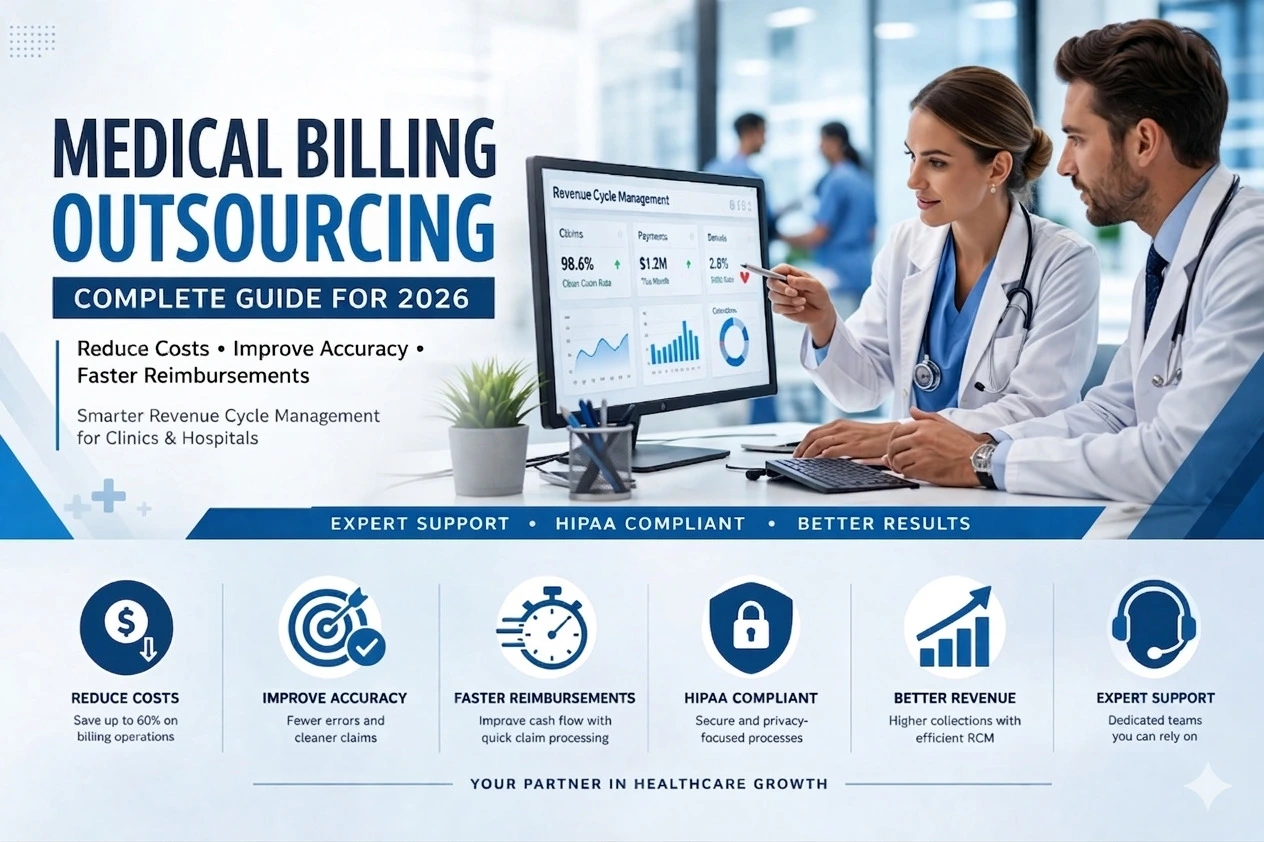
Healthcare providers in 2026 are facing increasing pressure to manage complex billing systems while maintaining high-quality patient care. As administrative workloads grow, many clinics and hospitals are turning to medical billing outsourcing to improve efficiency and reduce operational stress.
By outsourcing billing processes, healthcare outsourcing providers can streamline their revenue cycle management (RCM), reduce errors, and accelerate reimbursements. In this guide, you’ll learn how medical billing outsourcing works, its benefits, costs, risks, and how to choose the right partner.
What Is Medical Billing Outsourcing?
Medical billing outsourcing is the process of hiring a third-party company to manage billing, coding, and insurance claims for healthcare providers. It works by transferring revenue cycle tasks such as claim submission and follow-ups to specialists. Healthcare providers use it to reduce costs, improve accuracy, and speed up reimbursements.
Why Medical Billing Outsourcing Is Growing in 2026
The demand for medical billing outsourcing services is rising due to increasing administrative complexity and stricter healthcare regulations. The global market, valued at USD 18.20 billion in 2025, is projected to reach USD 50.47 billion by 2034, growing at a CAGR of 12.05%.
Cost efficiency is another major driver. Practices spend around 13.7% of their collections on in-house billing compared to just 5.4% when outsourcing. At the same time, over 60% of practices have reported rising claim denials, making professional claim denial management essential for maintaining steady revenue.
How Medical Billing Outsourcing Works
Step 1 — Patient Registration and Insurance VerificationAccurate patient data is collected and insurance eligibility is verified. This step reduces errors at the start of the revenue cycle management (RCM) process.
Step 2 — Medical Coding (ICD-10, CPT, HCPCS)Certified coders assign standardized codes such as ICD-10, CPT, and HCPCS. Many providers rely on medical coding outsourcing to ensure compliance and accuracy.
Step 3 — Claim SubmissionClaims are prepared and submitted electronically to insurance companies. Clean claims improve approval rates and reduce delays.
Step 4 — Denial Management and Follow-UpDenied claims are corrected and resubmitted quickly. Strong claim denial management helps recover lost revenue.
Step 5 — Payment Posting and ReportingPayments are recorded and reports are generated. This provides full visibility into financial performance.
Key Benefits of Outsourcing Medical Billing
- Significant Cost Reduction: Outsourcing reduces billing costs from 13.7% to around 5.4% of collections, making medical billing outsourcing highly cost-effective.
- Fewer Claim Denials: Advanced validation tools and expert review reduce errors before submission, lowering rejection rates.
- Faster Reimbursement Cycles: Dedicated teams follow up on claims quickly, improving cash flow and reducing delays.
- HIPAA Compliance and Regulatory Coverage: Providers ensure HIPAA compliant billing and stay updated with regulations, reducing compliance risks.
- Focus on Patient Care: Staff can focus on patient care instead of administrative tasks, improving overall service quality.
- Scalability: Outsourcing easily adapts to growing patient volumes without increasing internal workload.
Which Clinics and Hospitals Benefit Most from Medical Billing Outsourcing
- Small and Independent Clinics: Outsourcing eliminates the need for in-house billing staff. Medical billing for clinics becomes more affordable and efficient.
- Multi-Specialty Practices: Complex billing across specialties is handled with accuracy and consistency.
- Large Hospital Systems: Medical billing for hospitals improves efficiency and supports high claim volumes.
- Rural and Standalone Practices: Outsourcing provides expert support without requiring additional infrastructure.
In-House Medical Billing vs Outsourcing: What Is the Difference?
In-house billing requires hiring staff, investing in software, and managing compliance internally, which increases costs and workload. Outsourcing provides access to experienced professionals and advanced tools at a lower cost.
Outsourced billing improves accuracy, reduces denial rates, and offers better scalability. Compared to in-house vs outsourced billing, outsourcing delivers higher efficiency and more predictable revenue outcomes.
How to Choose the Right Medical Billing Outsourcing Company
Check Certification and HIPAA ComplianceChoose a provider that ensures HIPAA compliant billing and employs certified experts.
Ask About Denial Rates and Claim AcceptanceLook for providers with high first-pass acceptance and low denial rates.
Confirm EHR and EMR IntegrationEnsure compatibility with your existing systems for smooth workflow.
Understand the Pricing ModelSelect a pricing structure that aligns with your revenue goals.
Request Client ReferencesCheck case studies or testimonials from similar healthcare providers.
Potential Risks of Medical Billing Outsourcing and How to Avoid Them
- Data security and patient privacy: Work with providers that follow strict data protection standards.
- Loss of control and visibility: Choose partners that offer transparent reporting and real-time dashboards.
- Choosing the wrong provider: Evaluate experience, certifications, and client feedback carefully.
Is Medical Billing Outsourcing Right for Your Practice?
Medical billing outsourcing is a smart strategy for healthcare providers aiming to reduce costs, improve efficiency, and simplify operations in 2026. It helps streamline billing processes while ensuring compliance and accuracys.
Whether you run a clinic or a hospital, outsourcing allows you to scale operations, improve cash flow, and reduce administrative burden. Most importantly, it enables your team to focus on delivering better patient care.
If you're ready to optimize your billing process, SkyOS BPO offers reliable and scalable healthcare BPO services tailored to your needs. Get a free consultation today at info@skyosbpo.com
Leave A Comment