

L1 vs L2 vs L3 Technical Support: Differences, Roles & Responsibilities
27
Apr
- Admin
- 0 Comments
- Last Updated: October 7, 2026
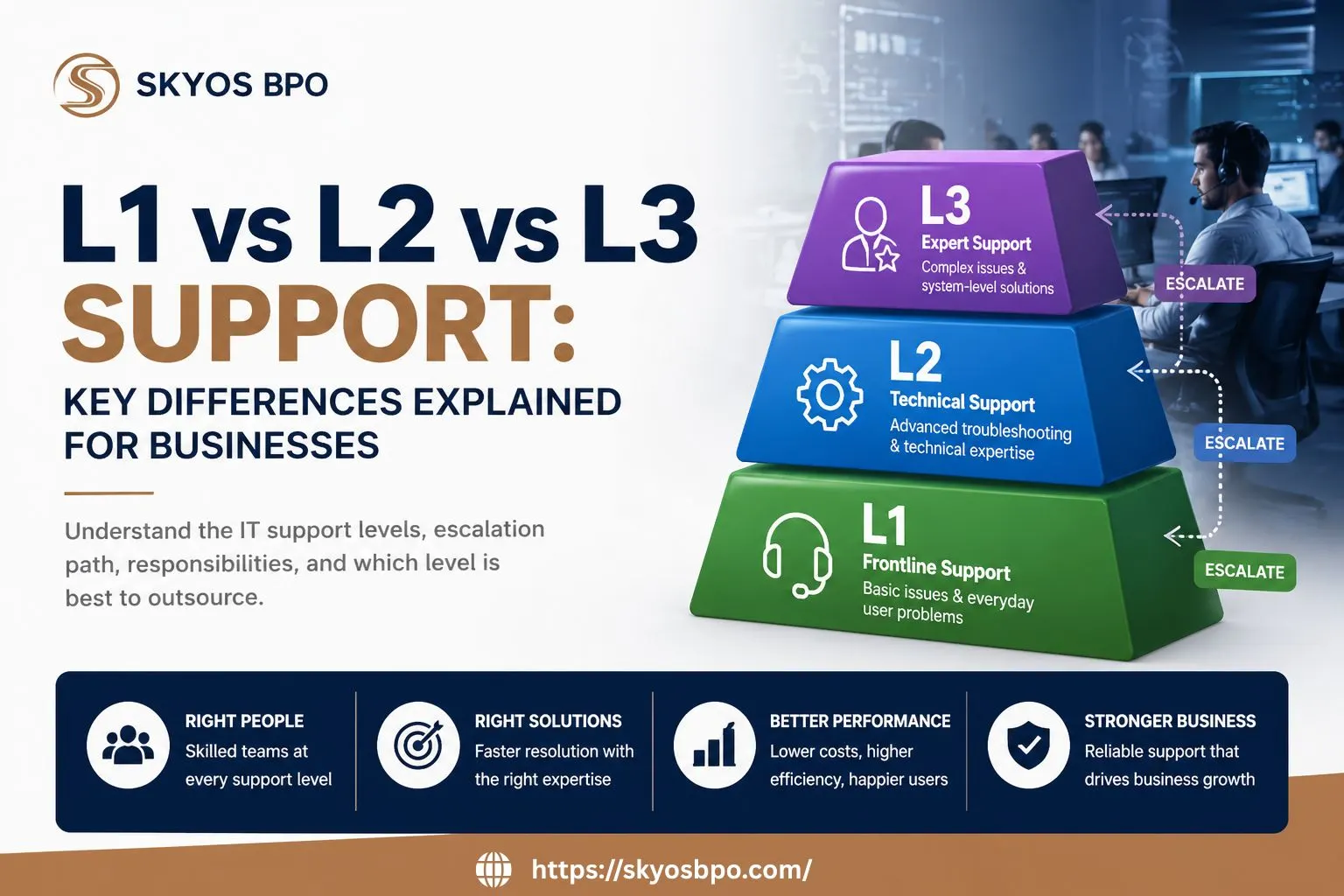
- L1, L2, and L3 support are the three levels of IT helpdesk support. L1 handles basic issues, L2 manages technical troubleshooting, and L3 resolves complex, system-level problems. The difference between L1, L2, and L3 support depends on issue complexity, expertise, and escalation level.
"L1 (frontline help desk) resolves common, well-documented issues like password resets and basic setup problems. L2 (technical support) handles deeper diagnostics — system logs, software conflicts, and configuration issues that L1 can't resolve with scripts alone. L3 (expert engineering support) tackles critical, code-level, or infrastructure-wide problems that require senior specialists. Each tier escalates to the next based on complexity, required access level, and resolution time."
Every time a user submits a support ticket, something happens behind the scenes that most people never think about. The ticket is assessed, categorised, and routed, sometimes resolved in minutes, sometimes escalated for deeper investigation.
That routing process follows a structured tiered support model, also known as L1 vs L2 vs L3 support, where IT issues are matched to the right level of expertise.
If your business relies on a technical helpdesk, whether in-house or outsourced, understanding the difference between L1, L2, and L3 support is essential. It impacts resolution speed, operational efficiency, and overall support costs.
This tiered model is widely aligned with IT service management frameworks such as ITIL, ensuring structured and efficient support operations.
What is L1 Support? (Level 1 — Frontline Help Desk)
L1 is where every support journey begins. Level 1 agents are your first line of contact, the people who answer the call, respond to the chat, and pick up the ticket when a user reports a problem.
L1 agents work from documented scripts, standard operating procedures, and a knowledge base. Their job is to resolve straightforward, well-defined issues in a single interaction wherever possible. The key performance metric at this level is First Contact Resolution (FCR), the percentage of tickets solved without needing to escalate further.
A well-run L1 team with good documentation can resolve between 40 and 70 percent of all incoming tickets at this level. That directly reduces the volume and cost of tickets that need to go higher.
✓ What does L1 handle?
- Password resets and account access issues
- Basic software installation and configuration queries
- Common error messages with documented fixes
- Printer, connectivity, and device setup problems
- Initial ticket logging, triage, and severity assessment
- User communication and status updates throughout the process
A user cannot log into their account after a system update. An L1 agent identifies an MFA configuration issue, resets the token via the admin panel, and closes the ticket within ten minutes. No escalation needed.
What is L2 Support? (Level 2 — Technical Support)
When an issue is too complex for L1 to resolve using standard procedures, it escalates to Level 2. L2 technicians are more experienced, typically system administrators, network engineers, or application support specialists, and they take a deeper approach to diagnosis.
Unlike L1 agents, who follow scripts, L2 technicians think critically. They access backend systems, review logs, replicate issues in controlled environments, and connect technical symptoms to their underlying causes. They don’t just fix the immediate problem, they often update knowledge base documentation so L1 can handle similar cases independently in the future.
✓ What does L2 handle?
- System and application log analysis
- Software conflicts, bugs, and compatibility issues
- Network connectivity and infrastructure problems
- Advanced configuration and admin-level system access
- Recurring issues that L1 is seeing repeatedly
- Creating or updating documentation for the L1 knowledge base
An email client keeps crashing despite a reinstall. L2 pulls the system event logs, identifies a conflict with a recent security patch, applies a targeted fix, and documents the resolution for future L1 reference.
What is L3 Support? (Level 3 — Expert Engineering Support)
L3 is the highest internal support tier, reserved for the most serious and technically complex issues. Level 3 engineers are senior specialists: architects, developers, and subject matter experts who have deep knowledge of the systems, infrastructure, and, in many cases, the code itself.
L3 support is both reactive and proactive. Reactively, they resolve critical failures that have defeated L1 and L2. Proactively, they identify systemic weaknesses, develop long-term fixes, and feed improvements back down to L2 and L1. Because L3 is expensive and specialised, the tiered model exists precisely to protect this tier from low-complexity work.
✓ What does L3 handle?
- Root cause analysis for recurring or high-impact incidents
- Code-level debugging, patching, and hotfix development
- Critical infrastructure failures and major outages
- Architectural review and redesign
- Collaboration with external vendors on complex issues
- Post-incident review and long-term preventative improvements
A customer portal goes down completely. L1 and L2 rule out common causes. L3 investigates the database layer, identifies corruption from a failed backup job, restores the system from a clean recovery point, and implements safeguards to prevent recurrence.
L1 vs L2 Support: What's the Real Difference?
L1 works from scripts and a knowledge base to resolve common, well-documented issues on the first contact. L2 goes further: technicians access backend systems, analyze logs, and diagnose problems that don't have a documented fix yet. The clearest signal an issue belongs with L2 rather than L1 is that it needs elevated system access or independent troubleshooting rather than a known procedure.
L2 vs L3 Support: When Does an Issue Need an Engineer?
L2 resolves technical issues within existing systems — configuration problems, software conflicts, network faults. L3 gets involved when the root cause sits deeper: in the code itself, in system architecture, or in infrastructure that's failing at scale. If a fix requires a code change, a vendor escalation, or touches a business-critical outage, it belongs with L3.
L1 vs L2 vs L3 Support: Key Differences at a Glance
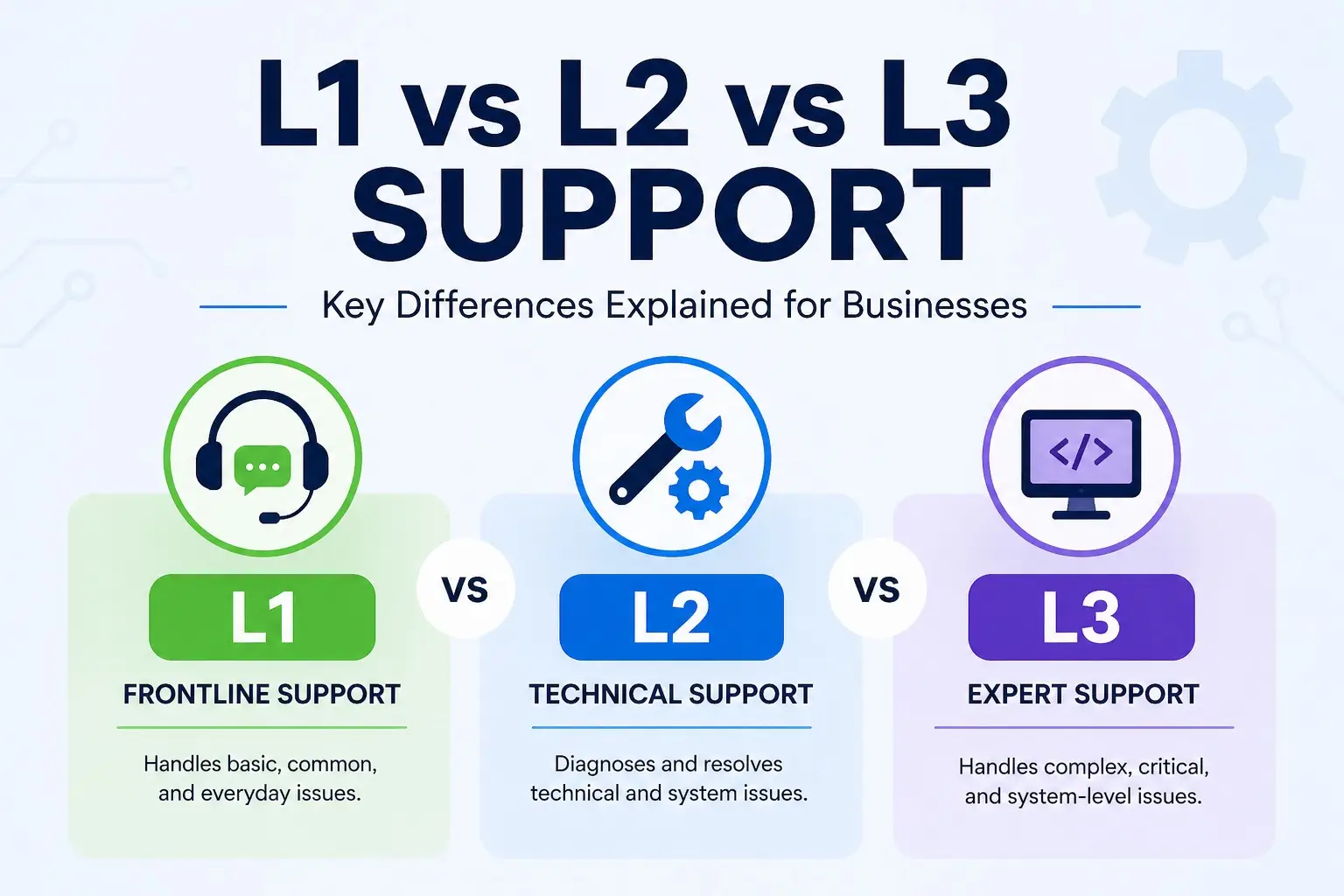
| Feature | L1 Support | L2 Support | L3 Support |
|---|---|---|---|
| Also known as | Help Desk / Frontline | Technical Support | Engineering / Expert Support |
| Who handles it | Entry-level agents | System admins, specialists | Senior engineers, architects |
| Issue type | Basic, repetitive | Technical, system-level | Critical, complex |
| Example issue | Password reset | Software crash | System outage |
| Resolution time | Minutes to 1 hour | Hours to 2 days | Days to weeks |
| Key metric | First Contact Resolution (FCR) | Mean Time to Resolve (MTTR) | Root Cause Analysis |
| Cost per ticket | Low | Medium | High |
What is L4 Support? (Optional Advanced Tier)
Some organisations extend the support model beyond L3 to include L4 support, which typically involves external vendors, product developers, or third-party service providers.
L4 is used when:- The issue involves proprietary software or hardware
- Vendor-level intervention is required
- Internal teams cannot resolve the issue
While not always included, L4 support plays a role in enterprise environments with complex systems.
When Does an Issue Move from One Level to the Next?
Escalation should never be guesswork. A well-structured IT support operation defines clear escalation criteria so tickets move up the chain at the right moment, with the right information attached.
L1 escalates to L2 when:- The issue cannot be resolved with standard scripts or knowledge base resources
- The fix requires backend system access or elevated permissions
- The ticket has been open longer than the agreed L1 resolution window, typically 30 to 60 minutes
- The same unresolved issue has been raised multiple times by the same user
- Root cause cannot be identified after full investigation
- The fix requires a code change, architectural modification, or vendor involvement
- The issue is causing or threatening a business-critical outage
Clean escalation matters. When L1 passes a ticket to L2, it should include complete logs, error messages, and every step already tried. When L2 escalates to L3, full replication steps and diagnostic data must travel with the ticket. Poor handoffs waste hours.
What Are Typical SLAs at Each Support Level?
Service Level Agreements (SLAs) define the expected response and resolution times at each tier. These vary by organisation and issue severity, but typical benchmarks look like this:| Support Tier | Initial Response | Target Resolution |
|---|---|---|
| L1 | Within 15–30 minutes | Under 1 hour for most tickets |
| L2 | Within 1–2 hours | 4 hours to 2 business days |
| L3 | Within 4 hours | 2 days to 2 weeks (depends on complexity) |
For businesses working with an outsourced support provider, SLAs form the contractual backbone of the relationship, defining exactly what performance levels are guaranteed at each tier.
Should Businesses Outsource L1, L2, or L3 Support?
Building and maintaining three internal support tiers is resource-intensive. To learn more about how to structure these operations effectively, read our full overview of L1, L2, and L3 technical support levels and how they scale within an outsourced model.
Outsourcing one or more tiers to a specialist BPO provider gives businesses access to structured, experienced support without the full cost of building it internally.- L1 is the most commonly outsourced tier, high volume, well-documented, and ideal for specialist helpdesk operations that offer 24/7 coverage and multilingual support
- L2 is increasingly outsourced when businesses need deep technical expertise across multiple platforms without the volume to justify full-time specialists
- L3 is typically kept in-house or partially outsourced for specific functions, security engineering, database management, and network architecture to specialist vendors
If you're considering scaling your helpdesk, explore our technical support outsourcing services to build a structured L1, L2, and L3 support system without the overhead of managing it in-house.
At SkyOS BPO, we provide structured L1, L2, and managed L3 technical support services for businesses across the UK, US, and global markets. Our teams operate with defined escalation paths, agreed SLAs, and full visibility into ticket resolution at every level, built around your systems, not a generic template.
How to Implement an L1, L2, and L3 Support Model
- Audit your current setup: Review ticket volume, resolution times, and escalation patterns to identify where bottlenecks exist today.
- Define the scope of each tier: Document clearly what L1, L2, and L3 are each responsible for. Ambiguity between tiers is the most common reason this model fails.
- Invest in documentation: Every issue resolved at L2 and L3 should generate a knowledge base entry so L1 can handle similar cases independently over time.
- Consider outsourcing: If building all three tiers in-house is not practical, partnering with SkyOS BPO gives you structured customer technical assistance across all levels from day one.
Conclusion
Understanding the difference between L1, L2, and L3 support is the first step toward building a helpdesk structure that actually works, one where the right issues reach the right people at the right speed, without overloading your most skilled engineers or leaving your users waiting.
If you're reviewing your technical support structure or considering outsourcing one or more tiers, the SkyOS BPO team can help you map the right model for your business. Ready to talk about your support structure? Get in touch with the SkyOS BPO team at info@skyosbpo.com to discuss L1, L2, and L3 technical support outsourcing.
Leave A Comment