

How L1, L2, and L3 Technical Support Levels Improve IT Support Efficiency
13
Mar
- Admin
- 0 Comments
- Last Updated: September 2, 2026
From our experience at SkyOS BPO, one of the most overlooked drivers of customer satisfaction is how well a business structures its technical support. A clearly defined support tier system changes everything.
If you are running a business that depends on technology, the way your team handles technical problems directly affects how customers feel about your brand. In our experience at SkyOS BPO, poorly structured IT support is one of the most common reasons customers become frustrated or stop using a service entirely. The L1, L2, and L3 technical support model solves this by matching every issue to the right level of expertise.
Why a Structured IT Support System Matters
When every issue, whether a simple password reset or a critical system failure, goes to the same team, the result is predictable. Simple problems take too long and complex problems do not get the expertise they need. Research shows that first contact resolution is one of the strongest predictors of customer satisfaction. Multi-level technical support is specifically designed to maximise that outcome.
From our experience, businesses that invest in structured IT support services see clear improvements in resolution speed, customer satisfaction scores, and overall team efficiency. The structure is not just an operational choice. It is a customer experience decision.
Understanding L1, L2, and L3 Technical Support Levels
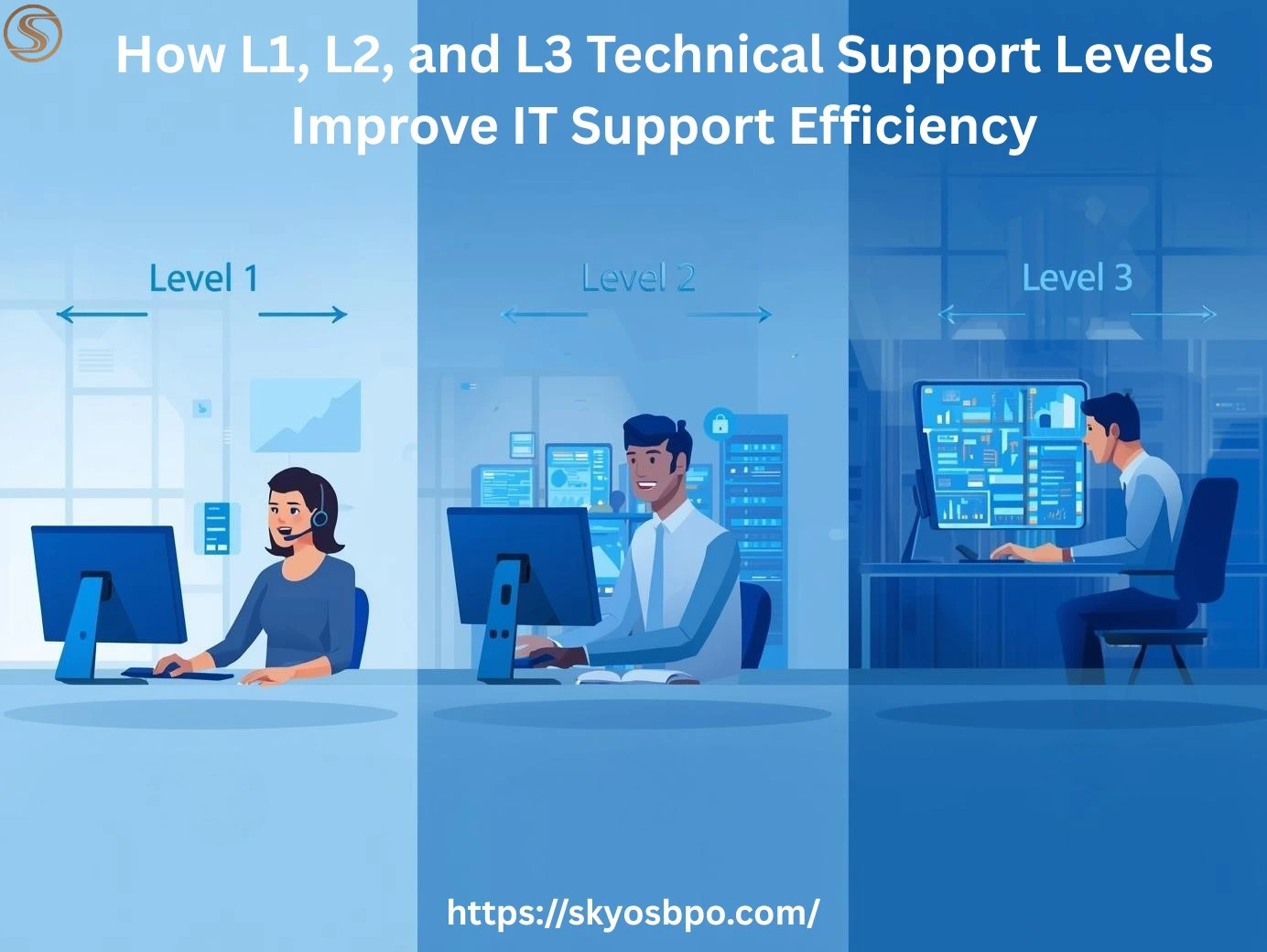
L1 Technical Help Desk Support
L1 is the first point of contact. This is your technical help desk support layer, handling password resets, account access issues, basic software guidance, and initial ticket logging. The goal is fast resolution for common problems so customers get help without unnecessary delay.
L2 Intermediate Technical Resolution
L2 handles issues that go beyond standard fixes. These agents investigate root causes rather than surface symptoms, covering software bugs, network configuration, and escalated account queries. Remote technical support services are commonly delivered at this level using direct system access.
L3 Expert Engineering Support
L3 involves senior engineers and developers who resolve problems at the code or infrastructure level. Critical bug fixes, security vulnerabilities, and server failures belong here. From our experience, most customers never reach L3, but when they do, a defined escalation path ensures they reach the right expert without delays.
Understanding how each support level works is important when designing an efficient IT support structure. Businesses can learn more about the key differences between L1, L2, and L3 support levels and how each tier handles different technical challenges.
How L1, L2, and L3 Technical Support Work Together
A customer raises a ticket. L1 picks it up, resolves it if possible, or passes it upward with clear notes. L2 investigates and either fixes the issue or escalates to L3. L3 resolves the root cause and documents the fix so that L1 and L2 can handle similar cases independently in the future.
At SkyOS BPO, we have seen this knowledge-sharing cycle directly reduce escalation rates and improve IT issue resolution services quality over time. The system becomes faster and smarter with every ticket that moves through it.
L1 vs L2 vs L3 Technical Support Comparison
| Support Factor | L1 | L2 | L3 |
|---|---|---|---|
| Response Speed | Immediate | Within a few hours | Based on severity |
| Issue Complexity | Basic and common | Intermediate technical | Advanced root-level |
| Typical Team | Help desk agents | Technical specialists | Engineers and developers |
| Escalation Role | Filters and routes | Investigates or escalates | Final resolution |
Key Benefits of Multi-Level Technical Support
From our experience, businesses that adopt structured IT service management support consistently deliver better customer outcomes. Here is what the model actually delivers:- Faster first response. L1 is always ready. Customers are not left waiting while issues are triaged.
- Right expertise for every problem. Issues are not over-escalated. Each case lands with the right person.
- No repetition for the customer. Full context is passed upward at every handoff. Customers explain their issue once.
- Better team efficiency. Senior engineers focus on complex problems. Help desk agents handle volume. Burnout reduces and quality improves.
- Stronger managed IT support solutions over time. As knowledge transfers between tiers, fewer issues require escalation and resolution becomes faster across the board.
How to Implement an L1, L2, and L3 Support Model
- Audit your current setup: Review ticket volume, resolution times, and escalation patterns to identify where bottlenecks exist today.
- Define the scope of each tier: Document clearly what L1, L2, and L3 are each responsible for. Ambiguity between tiers is the most common reason this model fails.
- Invest in documentation: Every issue resolved at L2 and L3 should generate a knowledge base entry so L1 can handle similar cases independently over time.
- Consider outsourcing: If building all three tiers in-house is not practical, partnering with SkyOS BPO gives you structured customer technical assistance across all levels from day one.
Final Thoughts
In 2026, businesses that deliver the strongest customer technical assistance are not always the ones with the largest teams. They are the ones with the most structured approach. From our experience at SkyOS BPO, a well-defined L1, L2, and L3 model transforms IT support from a reactive cost centre into a real competitive advantage.
IT issue resolution does not have to be slow or frustrating for anyone involved. The right structure makes every interaction more efficient and every customer feels properly supported. If you would like to explore how structured technical support could work for your business, reach us directly at info@skyosbpo.com and we will be happy to discuss a solution tailored to your needs.
Leave A Comment