

Everything You Should Know About Healthcare BPO Solutions

26
Nov
- Admin
- 0 Comments
- Last Updated: October 7, 2026
The management of a healthcare organization today is not only restricted to the treatment of patients. It also includes a lot of paperwork, billing, data management, compliance with regulations, etc. Gradually, these additional tasks can draw the attention of healthcare teams away from the primary goal of patient care. Healthcare BPO Solutions are the ones who step in at this point; they handle all non-clinical activities, thus allowing hospitals and clinics to concentrate on their core functions.
In this complete guide to healthcare process outsourcing, we cover what it is, how it works, market size, benefits, key services, how to choose the right partner, and why more healthcare business process outsourcing companies are becoming essential to modern medical operations.
What is Healthcare BPO?
Healthcare Business Process Outsourcing (BPO) is the outsourcing of administrative and back office work to a third party service provider that specializes in the area. The healthcare BPO covers various processes such as billing, claims, data entry, and patient assistance among others, so medical personnel can spend their time and energy on providing care rather than on paperwork.
Essentially, the outsourcing of healthcare services allows the hospitals, clinics, and medical institutions to manage their operations in a more efficient manner. The services come with accuracy, cost saving, and certainty that the processes are running without hiccups as the benefits.
It is important to clarify a distinction that often gets blurred: Healthcare outsourcing is a broader term that can encompass clinical functions such as telemedicine and diagnostic services. Healthcare BPO specifically refers to administrative and operational processes — the functions that support care delivery without being part of it directly.
Healthcare Business Process Outsourcing Services
Healthcare business process outsourcing services cover the full range of non-clinical functions that keep a medical practice running, from medical billing and claims management to data entry, transcription, and patient support. Instead of building every function in-house, healthcare organizations partner with a specialized provider that already has trained staff, secure systems, and healthcare-specific workflows in place. This makes it possible to launch or scale a service, such as revenue cycle management or a 24/7 patient helpline, in weeks rather than months, without the overhead of recruiting, training, and retaining an internal team.
Healthcare Process Outsourcing — How It Works
Healthcare process outsourcing typically follows a structured, end-to-end workflow. It begins with patient registration and insurance eligibility verification, moves through medical coding and claims submission, and continues with payment posting, denial management, and accounts receivable follow-up. Supporting functions, including data entry, transcription, and patient communication, run in parallel to keep records accurate and patients informed at every step. A capable outsourcing partner maps this workflow to your existing systems (EHR, practice management, or billing software), so data moves securely between your in-house team and the outsourced team, with clear SLAs and reporting at each stage.
BPO Services for Healthcare Companies
BPO services for healthcare companies go beyond hospitals and clinics. They also support insurance payers, diagnostic labs, telehealth platforms, and healthcare technology companies. Common engagements include claims adjudication support for payers, back-office data management for labs, virtual scheduling and onboarding for telehealth platforms, and AI data annotation for companies building diagnostic or imaging models. Because these organizations often operate across different regulatory environments, a healthcare BPO company needs to demonstrate compliance experience beyond HIPAA, including GDPR for UK/EU clients and HITRUST for enterprise payers.
Medical Business Process Outsourcing
Medical business process outsourcing (medical BPO) refers specifically to the administrative processes tied to clinical documentation and reimbursement, including medical coding, medical billing, transcription, and charge entry. It's a subset of the broader healthcare BPO category, focused on the financial and documentation side of patient care rather than scheduling or customer support. Medical BPO services are typically staffed by coders and billers trained in ICD-10, CPT, and HCPCS coding standards, which directly affects claim accuracy and reimbursement speed.
Why Choose SkyOS BPO for Healthcare Outsourcing?
SkyOS BPO is an ICO-registered, GDPR-compliant healthcare BPO provider based in Mohali, India, supporting healthcare organizations across the UK, US, and other global markets. Every client is assigned a dedicated account manager from day one, giving you a single point of contact for onboarding, reporting, and day-to-day issue resolution instead of a rotating queue of support tickets. Combined with HIPAA-aligned data handling practices and scalable teams for billing, claims, data entry, and patient support, SkyOS BPO is built to be an operational partner, not just a vendor. To discuss your requirements, reach out to info@skyosbpo.com
Why Healthcare Organizations Outsource Their Processes
Over the years, healthcare providers have realized that outsourcing is not just a cost saving measure; it’s a strategic advantage. Let me explain a few reasons why many healthcare institutions prefer outsourcing their administrative and support services.
Focus on Core Medical Care:
Less time managing paperwork means more time for patient care.
Reduced Costs:
Outsourcing can lead to big operational cost reduction by the mere fact that they do not have to make much investment in staff training, infrastructure, and technology.
Access to Skilled Professionals:
The professionals that outsourcing partners have are the best in the medical billing, coding and other healthcare operations departments thus ensuring both accuracy and compliance.
Regulatory Compliance:
Healthcare BPOs must follow the highest standards of privacy and security like HIPAA which protects patient data and ensures confidentiality. Advanced partners also comply with GDPR and HITRUST standards, which is increasingly important for organizations operating internationally.
Scalability:
Outsourcing is a solution that allows even the smallest of clinics or the biggest hospitals to easily adapt to the changes in demand for their services without the hassle of hiring extra staff.
Addressing Staff Shortages :
A growing reason for outsourcing is the worsening healthcare staffing crisis. Studies project that over 6.5 million medical workers may permanently leave the industry by 2026. Healthcare BPO services help fill these gaps by providing remote trained teams for administrative roles, reducing burnout among clinical staff.
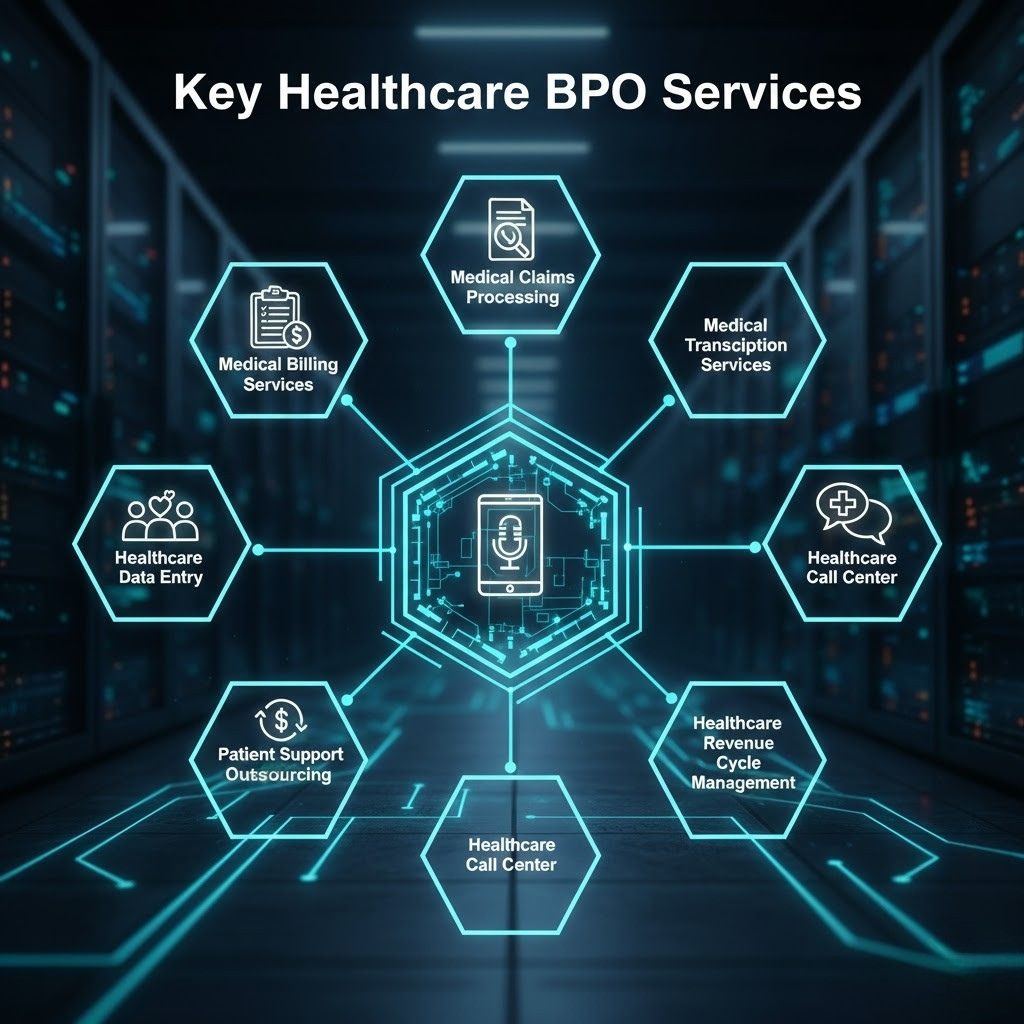
Key Healthcare BPO Services
There are many different types of services covered under healthcare BPO. Here are some of the most essential ones that make a big difference for healthcare providers.
| Service | Description |
|---|---|
| Medical Billing Services | Handles accurate billing and claim submissions to ensure timely payments. |
| Medical Claims Processing | Manages insurance claims, verification, and approvals efficiently. |
| Healthcare Data Entry | Digitizes patient records, reports, and administrative documents. |
| Medical Transcription Services | Converts voice recorded medical reports into written documents. |
| Healthcare Call Center | Provides round the clock patient assistance and appointment management. |
| Patient Support Outsourcing | Helps manage patient inquiries, scheduling, and follow ups. |
| Healthcare Revenue Cycle Management | Monitors the entire process from patient registration to final payment. |
| Healthcare Customer Support | Ensures effective communication between patients, providers, and insurance companies. |
| Healthcare Back Office Solutions | Supports administrative functions like record maintenance and compliance tracking. |
| Telehealth BPO Support | Manages virtual scheduling, patient onboarding, remote monitoring, and documentation for telehealth platforms. |
| AI Data Annotation | Provides labeled datasets for AI model development in medical imaging and diagnostics. |
| HR & Payroll Outsourcing | BPO teams handle payroll, benefits, and training, reducing HR overhead for healthcare providers. |
Each of these services plays a role in ensuring healthcare providers run smoothly without delays or errors.
Benefits of Healthcare BPO Solutions
Let’s explore how outsourcing can transform your healthcare operations.1. Enhanced Efficiency
Healthcare BPO providers adopt cutting-edge technology along with skilled staff to handle repetitive and time-consuming administrative tasks. Hence, the activity of manual error occurrence is reduced and the speed of data entry, billing, and claims gets increased. For example, providers working with dedicated healthcare BPO companies consistently report claim denial rates below 4% and accounts receivable days under 35.
2. Cost Savings
Healthcare organizations by outsourcing non-clinical tasks save money on hiring, training, and keeping in-house teams. The outsourcing partners already possess the expertise and technology required to carry out these tasks efficiently.
3. Improved Patient Experience
Your in-house staff can handle more of the personalized care when the external party takes care of the administrative work. The satisfaction of the patients goes up when the focus shifts back to care instead of paperwork.
4. Better Data Management
Healthcare generates massive amounts of data on a daily basis. Through outsourcing, it is guaranteed that all the records, reports, and documents are kept accurately and securely. Modern healthcare back office solutions now include cloud-based systems for real-time document access, automated validation, and structured data storage that integrates with EHR platforms.
5. Compliance and Security
Healthcare BPO companies follow strict laws regarding data protection and privacy standards. In 2024 alone, data breaches exposed over 276 million patient records (HIPAA Journal). Top bpo healthcare companies use advanced encryption, multi-factor authentication, AI-driven threat monitoring, and regular audits to prevent violations and maintain patient trust.
6. Scalable and Flexible Solutions
Outsourcing offers flexibility to increase or decrease depending on patient volume or seasonal demand. Without affecting the main operations, you can add or reduce support.
7. Reduced Nurse Administrative Burden
A study found that the average nurse spends 59.78 minutes per four-hour block on administrative tasks — more than the 58.71 minutes spent with patients. By partnering with a healthcare BPO provider, clinical staff can reclaim that time and focus on delivering better patient outcomes.
How Healthcare BPO Supports Revenue Growth
Healthcare BPO services directly contribute to better financial performance through accurate healthcare revenue cycle management. From patient registration and insurance verification to billing and payment collection, every step affects the financial health of your organization.
Here’s how outsourcing helps:- Accurate medical coding and documentation reduces the number of claims that get denied.
- Billing error minimization leads to faster reimbursements.
- Payment cycles are more transparent.
- Financial staff can spend time on analytics and strategy instead of entering data manually.
The RCM segment dominates the healthcare BPO industry because it manages the full lifecycle of a patient account — from appointment scheduling to final payment — across claim submission, follow-up, billing, and coding.
The Role of Technology in Healthcare BPO
Technology is at the heart of every successful outsourcing solution. Modern healthcare BPOs use automation, artificial intelligence, and cloud based tools to improve accuracy and speed.
For instance:- Automation reduces manual data entry.
- AI-driven analytics helps identify errors and predict claim rejections.
- Cloud systems ensure secure and real-time access to patient records.
These technologies make it easier to manage huge amounts of data without compromising accuracy or security.
When Should You Consider Healthcare BPO?
If your healthcare organization is facing one or more of the issues listed below, it might be a good time to think about outsourcing:
- Patients wait for a long time because of delays in the administrative process.
- Billing or claims rejections are common.
- Burnout among staff and high turnover.
- Keeping up with compliance requirements is a challenge.
- Limited time for patient care because of the large volume of paperwork.
You may be able to eliminate these difficulties through outsourcing and enjoy a more streamlined process.
Healthcare BPO and Patient Care
Outsourcing might not look like it is connected with patient care at first, but it has a great influence. If the healthcare staff who are usually doing the administrative work are provided with more time, they can give this time and attention to medical care of the highest quality.
A healthcare call center or a patient support team, that is well managed, is making sure that the patients are getting fast and trustworthy assistance for making appointments, billing, insurance questions, and other issues. The help given in this way is very quick, so it gradually gains trust, satisfaction and the experience overall is even smoother.
Challenges in Healthcare Outsourcing
While healthcare BPO offers many benefits, it’s not without challenges. Some of the most common include:
- Data privacy is a major concern since handling sensitive medical records requires strict confidentiality.
- Communication barriers caused by time zone differences or unclear instructions.
- Quality assurance issues if consistent monitoring is not maintained.
Selecting a reliable and experienced outsourcing partner is the most effective way to tackle these challenges.
Future of Healthcare BPO
Healthcare outsourcing services are anticipated to witness a fast paced growth in demand over the upcoming years. With the gradual digitization of the healthcare industry, outsourcing will emerge as an essential contributor in dealing with administrative complexities, cost cutting, and patient involvement.
Advancing technologies such as AI-powered automation, telemedicine assistance, and forecasting analytics will eventually open up new avenues for the BPO companies to create value for the healthcare sector.
Conclusion
Outsourcing of healthcare BPO services has been a powerful force in transforming daily operations at medical institutions. Such services allow hospitals and clinics to dedicate more time and resources to the most important aspect of their work: patient care.
Medical billing aligned with coding, auditing, and payment posting are just a few of the services that enable a more organized workflow, higher accuracy, and cost control.
If your healthcare organization aims for better efficiency while maintaining the same standard of quality in care, considering BPO solutions would be a wise next step.
As the healthcare BPO industry grows toward $694 billion by 2030, organizations that embrace outsourcing strategically — not just as a cost-cutting tactic, but as an operational partnership — will be best positioned to deliver quality care, stay compliant, and remain financially sustainable.
For more details or to learn about healthcare outsourcing, you can reach out to SkyOS BPO, located in Mohali, India, at info@skyosbpo.com.
Leave A Comment